TL;DR: The Anti-Kickback Statute (AKS) makes it a felony to offer or receive anything of value in exchange for patient referrals involving federal healthcare programs. For hospice and home health agencies, this means you can't pay for referrals, tie marketing compensation to admissions, or offer gifts to referral sources. But the AKS doesn't prohibit marketing itself — it prohibits specific financial arrangements. Understanding the difference between what's prohibited and what's permitted is the difference between building your agency and facing a federal investigation. This article explains the statute, the safe harbors, the recent enforcement trends, and the practical line between compliant and non-compliant marketing activity.
Table of Contents
- Why Every Hospice Operator Needs to Understand AKS
- What the Statute Actually Says
- The "One Purpose" Test: Why Intent Matters
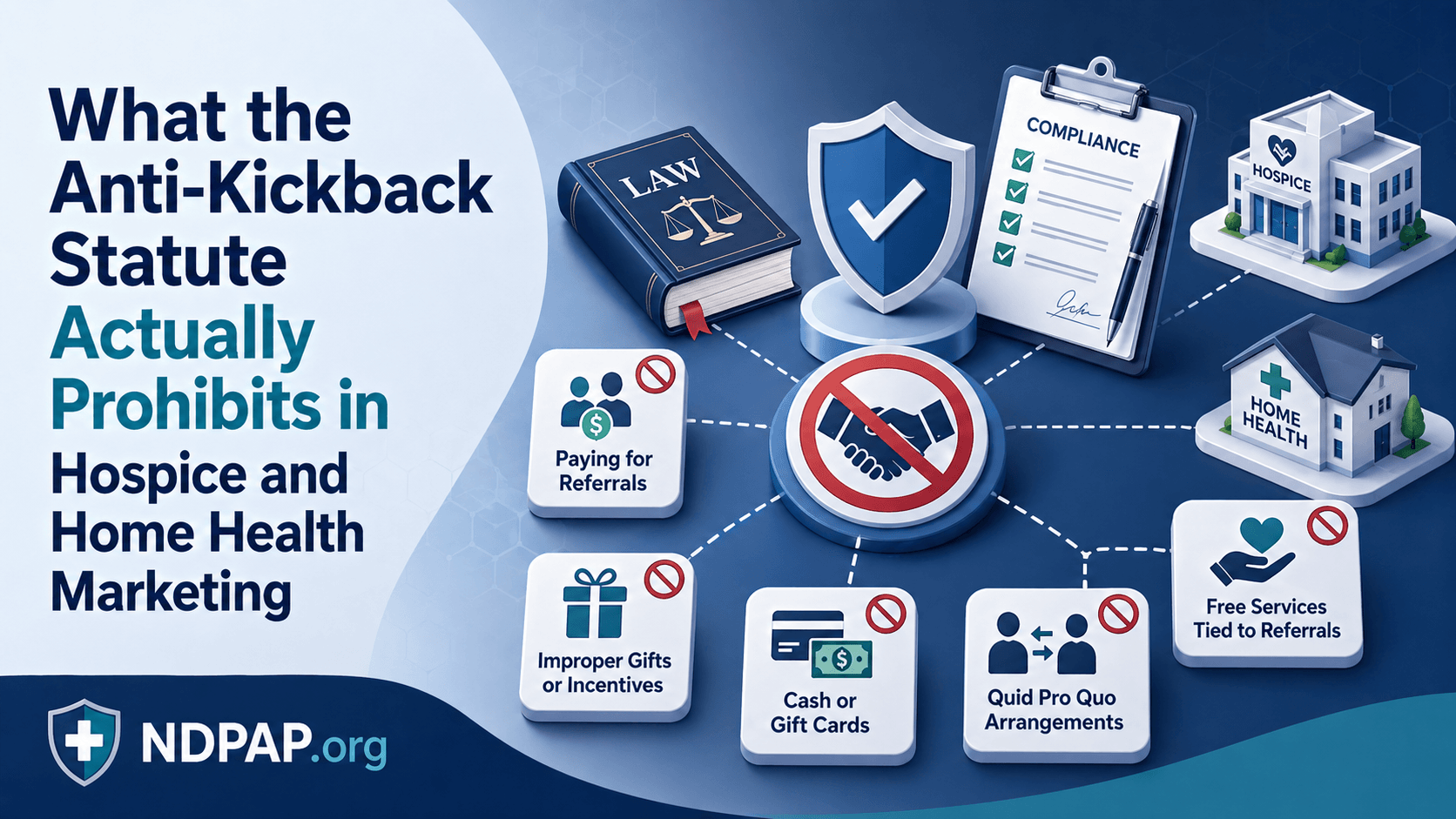
- What's Explicitly Prohibited in Marketing
- The Safe Harbors: What the Law Protects
- What You CAN Do: Compliant Marketing Activities
- How Marketing Compensation Gets Agencies in Trouble
- Recent Enforcement: What OIG Is Targeting in 2025–2026
- The Digital Marketing Question: Does AKS Apply Online?
- Building a Compliance-First Marketing Culture
- Frequently Asked Questions
Why Every Hospice Operator Needs to Understand AKS {#why-you-need-to-understand}
The Anti-Kickback Statute is not an obscure regulation that only lawyers worry about. It is the single most consequential compliance law in hospice and home health marketing, and OIG enforcement against hospice providers has escalated dramatically.
In 2024, the HHS Office of Inspector General documented approximately $143.81 million in alleged hospice fraud enforcement actions, according to OIG enforcement data. In 2025, CMS reported referring 343 suspected fraud cases to law enforcement, representing approximately $3.4 billion in alleged fraudulent billing, per enforcement reporting from Hospice News. In April 2026, eight individuals were arrested in a $50 million California hospice fraud scheme that included anti-kickback violations — specifically, illegal payments made in exchange for patient referrals, as reported by OIG.
The DOJ Health Care Fraud Data Fusion Center, announced in June 2025, now combines CMS billing data with OIG investigative data and AI-driven analytics to identify billing outliers and suspicious referral patterns across the country. Enhanced oversight under the Provisional Period of Enhanced Oversight (PPEO) now applies in Arizona, California, Nevada, Texas, Georgia, and Ohio, according to hospice compliance analysis.
This is the enforcement environment your marketing operates in. Understanding the AKS isn't optional — it's existential.
What the Statute Actually Says {#what-it-says}
The Anti-Kickback Statute is codified at 42 U.S.C. § 1320a-7b(b). In plain language, it prohibits two things:
1. Offering or paying remuneration to induce referrals. It is illegal to knowingly and willfully offer, pay, solicit, or receive anything of value to induce or reward the referral of patients for services covered by a federal healthcare program (Medicare, Medicaid, TRICARE, etc.).
2. Offering or paying remuneration to induce purchasing, leasing, ordering, or arranging for items or services. This extends beyond direct referrals to any arrangement that generates business payable by federal programs.
The key term is "remuneration," which the statute defines broadly. It is not limited to cash payments. Remuneration includes anything of value: gifts, free services, below-market rent, meals, entertainment, travel, excessive compensation for consulting or medical directorships, free equipment or supplies, and even favorable contractual terms that don't reflect fair market value.
Criminal and Civil Penalties
An AKS violation is a felony. Penalties include fines of up to $100,000 per violation, up to 10 years in prison, civil monetary penalties of up to $100,000 per violation plus triple damages, and exclusion from all federal healthcare programs (which, for a Medicare-dependent hospice, means closure), according to legal analysis from Phillips & Cohen.
The False Claims Connection
Under the Affordable Care Act, a claim resulting from an AKS violation is automatically considered a false claim under the False Claims Act. This means that every patient admission generated through a kickback arrangement is a separate false claim — multiplying the financial exposure dramatically.
The "One Purpose" Test: Why Intent Matters {#one-purpose-test}
The AKS does not require that a kickback be the only reason for a payment. Under the "one purpose" test established by federal courts, a payment violates the AKS if even one purpose of the payment is to induce referrals. This is critical for hospice operators to understand because it means arrangements that have legitimate purposes can still violate the law if inducing referrals is any part of the motivation.
For example: paying a physician a legitimate consulting fee (fair market value, for real services rendered) violates the AKS if part of the reason you hired that physician is to incentivize them to refer patients to your agency. The legitimate consulting work doesn't immunize the arrangement — the referral motivation contaminates it.
What's Explicitly Prohibited in Marketing {#whats-prohibited}
Based on OIG guidance, enforcement actions, and the statute itself, here are the marketing activities that are clearly prohibited for hospice and home health agencies:
Direct Pay-for-Referral Arrangements
Any arrangement where a referral source receives payment — cash, gifts, favors, or anything of value — in exchange for directing patients to your agency. This includes paying nursing home staff, hospital employees, physicians, social workers, or any other individual for patient referrals.
Per-Referral or Per-Admission Compensation for Marketers
Compensating your marketing representatives (whether employees or contractors) on a per-referral, per-admission, or commission basis tied to the volume or value of patients they bring in. According to analysis from Hospice News, this is one of the most common ways hospice agencies inadvertently (or intentionally) violate the AKS.
Gifts to Referral Sources
Providing meals, gift cards, event tickets, free services, or other items of value to physicians, discharge planners, nursing home administrators, or other individuals who are in a position to refer patients to your agency. Even small gifts can trigger AKS liability — there is no "de minimis" exception in the statute itself (though OIG has indicated in guidance that nominal gifts under certain circumstances may present low risk).
"Free" Services to Facilities That Refer Patients
Providing free nursing services, free equipment, free training, free staffing, or other services to hospitals, nursing homes, or assisted living facilities that refer patients to your agency — when those services are not at fair market value and are connected to an expectation of referrals.
Sham Arrangements
Medical directorships, consulting agreements, or teaching arrangements where the compensation exceeds fair market value for the actual services rendered, or where the real purpose is to secure referrals. According to Holland & Hart's analysis, medical director arrangements are a frequent area of AKS scrutiny in hospice.
Lease Arrangements Below Market Value
Renting office space in or near a hospital or nursing facility at below-market rates, where the arrangement's purpose includes securing referral access. This applies in both directions — providing space to referral sources below market value is equally problematic.
The Safe Harbors: What the Law Protects {#safe-harbors}
The OIG has established regulatory safe harbors — specific types of arrangements that are protected from AKS prosecution if all requirements are met. Safe harbors don't create exceptions to the law. They create protected zones where specific arrangements, structured precisely, are deemed not to violate the statute.
Safe Harbors Relevant to Hospice Marketing
Bona Fide Employee Safe Harbor. An employer can pay an employee based on any compensation structure, including bonuses tied to performance metrics, as long as the relationship is a true W-2 employment relationship. However, even under this safe harbor, OIG has cautioned that compensation heavily weighted toward referral volume raises compliance risks. The safe harbor protects the arrangement from criminal prosecution, but it doesn't prevent OIG from viewing it as suspicious.
Personal Services and Management Contracts Safe Harbor. Payments to independent contractors (including marketing consultants) are protected if the arrangement is in writing, signed by the parties, specifies the services to be provided, covers compensation that is set in advance, is at fair market value, and does not vary with the volume or value of referrals.
Space and Equipment Rental Safe Harbor. Lease arrangements are protected if the lease is in writing, the term is at least one year, the space or equipment is specified, the rental amount is set in advance, reflects fair market value, and does not vary with referral volume.
The Critical Requirement
Every safe harbor shares a common requirement: compensation must be set in advance, reflect fair market value, and not be determined by the volume or value of referrals. When any of these elements is missing, safe harbor protection is lost, and the arrangement is evaluated on its "facts and circumstances."
What You CAN Do: Compliant Marketing Activities {#what-you-can-do}
The AKS prohibits paying for referrals. It does not prohibit marketing, advertising, community education, or building relationships with referral sources through legitimate, non-financial means.
Clearly Compliant Activities
| Activity | Why It's Compliant | |---|---| | Advertising (print, digital, radio, TV, directory listings) | You're paying for advertising space, not for referrals. No remuneration flows to a referral source. | | Content marketing (blog posts, educational articles, social media) | Educational content that informs the public is not a referral inducement. | | Community education (health fairs, caregiver seminars, community presentations) | Providing free education to the community is not remuneration to a referral source. | | Google Business Profile and directory listings (NDPAP, Healthgrades, etc.) | Listing your business in directories is standard advertising, not a kickback arrangement. | | Website and SEO optimization | Improving your website to attract family searches involves no payment to referral sources. | | Sending educational materials to referral sources | Providing clinical or educational materials (not gifts) is generally permissible. | | Meeting with referral sources to discuss your services | Relationship building through meetings and presentations is standard industry practice — as long as you're not providing gifts or other remuneration. | | Hiring a marketing employee on a fixed salary | Under the bona fide employee safe harbor, employees can be paid salary or hourly wages not tied to referral volume. |
The Critical Distinction
The line between compliant and non-compliant marketing is not about the activity — it's about the financial arrangement. Meeting with a discharge planner to explain your services is fine. Bringing a $200 gift basket to that meeting is not. Running Google Ads for "hospice care in [city]" is fine. Paying a physician $500 for every patient they send you is a felony.
As the Seventh Circuit clarified in 2025, payments to marketers and advertisers for ordinary advertising and marketing activities — where the marketer never actually referred patients — are not illegal under the AKS. The violation occurs when payments are connected to the actual routing of patients to a provider.
How Marketing Compensation Gets Agencies in Trouble {#compensation-problems}
The single most common AKS compliance failure in hospice marketing is how agencies compensate their marketing staff. Here is the spectrum from clearly compliant to clearly illegal:
Compensation Structures: Green, Yellow, and Red
| Structure | Risk Level | Analysis | |---|---|---| | Fixed salary with no referral-based bonus | Green | Protected under bona fide employee safe harbor | | Fixed salary with bonus for non-referral metrics (calls made, events attended) | Green | Activity-based metrics that don't tie to admissions | | Fixed salary with bonus partially tied to admission volume | Yellow | Technically within employee safe harbor, but OIG views this as high risk | | Salary plus commission per admission | Red | Per-admission compensation is the hallmark of an AKS violation | | Independent contractor paid per referral | Red | Outside employee safe harbor; per-referral pay to non-employees is clearly prohibited | | Independent marketing firm paid percentage of revenue from referred patients | Red | Compensation tied to volume/value of referrals |
The Medical Director Problem
In hospice, medical directors are often direct employees who also certify terminal illness and may refer patients. OIG guidance specifically identifies this arrangement as a compliance risk area. A medical director arrangement is permissible when the medical director is a bona fide employee, compensation reflects fair market value for the actual medical director duties performed, compensation is not inflated to reward referral activity, and the medical director is not a shareholder in the hospice. When any of these conditions aren't met, the arrangement becomes scrutiny-worthy.
Recent Enforcement: What OIG Is Targeting in 2025–2026 {#recent-enforcement}
Understanding current enforcement priorities helps you focus your compliance efforts on the areas where regulators are most active.
The California Crackdown
CMS Administrator Oz has stated that federal officials plan to review every hospice in California by year's end, with "clusters" of similar takedowns expected every few months throughout 2026. The April 2026 arrests involved eight individuals across seven hospice agencies in Los Angeles County, with combined fraudulent billing exceeding $50 million. Anti-kickback violations — specifically illegal payments in exchange for referrals — were among the charges, per OIG enforcement records.
Enhanced Oversight States
As of 2026, the Provisional Period of Enhanced Oversight (PPEO) applies to new hospice providers in Arizona, California, Nevada, Texas, Georgia, and Ohio. Agencies in these states face heightened scrutiny from day one, including pre-payment claims review and elevated risk of referral to OIG and DOJ.
AI-Powered Detection
The DOJ Health Care Fraud Data Fusion Center, launched in 2025, uses AI analytics to identify billing outliers and suspicious referral patterns. This means patterns that once took years to detect — like a sudden spike in admissions from a single referral source — can now be flagged in real time.
What This Means for You
Even if your agency is not in a PPEO state and has never engaged in fraudulent billing, the enforcement environment affects you. Referral sources are increasingly cautious about any arrangement that could be construed as a kickback. Hospitals are tightening their own compliance programs. And the digital trail of your marketing activities — emails, texts, CRM records, compensation agreements — is more accessible to investigators than ever before.
The Digital Marketing Question: Does AKS Apply Online? {#digital-marketing}
Yes, but not in the way most agencies fear.
Digital advertising (Google Ads, Facebook Ads, SEO, directory listings) does not implicate the AKS because you're paying for advertising placement, not for referrals. The money goes to Google or Facebook, not to a referral source.
Content marketing and social media are standard marketing activities that don't involve remuneration to referral sources.
Online directory listings (including NDPAP, Healthgrades, and Caring.com) are advertising expenses, not referral payments.
Where AKS does apply online: If you're paying online "lead generation" companies on a per-referral or per-admission basis — where the company identifies patients and routes them to your agency in exchange for per-patient fees — that arrangement likely violates the AKS. The medium is digital, but the structure (per-referral payment) is the same as a traditional kickback.
Similarly, if you're using telehealth platforms or patient intake services where the platform receives compensation tied to the number of patients it sends you, the AKS applies regardless of the technology involved.
Building a Compliance-First Marketing Culture {#compliance-culture}
The goal isn't to avoid marketing — it's to market aggressively within legal boundaries. The agencies that thrive are the ones that understand exactly where the line is and build their growth strategy right up to it.
Practical Steps
Document everything. Every marketing arrangement should be in writing. Compensation terms should be explicit. If you're paying a marketing employee or contractor, the agreement should specify that compensation is not based on referral volume.
Train your marketing team. Every person who represents your agency to referral sources needs to understand AKS basics. They need to know they cannot offer gifts, cannot promise favorable treatment in exchange for referrals, and cannot imply that referring patients will result in any benefit to the referral source.
Audit your compensation structures. Review how every marketing-related employee and contractor is compensated. If any component is tied to admissions, referrals, or census — even indirectly — consult with a healthcare compliance attorney.
Separate marketing from intake. The people who build relationships with referral sources should not be the same people who track referral-to-admission conversion rates. This separation reduces the appearance (and reality) of referral-based incentives.
Get legal review for new arrangements. Before entering into any new financial relationship with a referral source — including medical director agreements, space leases, consulting arrangements, or joint marketing — have it reviewed by a healthcare attorney who understands AKS.
Frequently Asked Questions {#faq}
Can I bring food to a hospital when visiting discharge planners?
This is a gray area. OIG has not issued a blanket prohibition on nominal gifts, but any gift to a referral source creates AKS risk. Many hospitals have their own policies prohibiting staff from accepting gifts from vendors. The safest approach: don't bring gifts. If your clinical reputation and service quality can't sustain a referral relationship without food, the relationship isn't built on the right foundation.
Can I pay a marketing company to generate leads?
Yes — if the marketing company is paid a flat fee or hourly rate for marketing services (advertising, content creation, social media management) and is not compensated on a per-lead or per-referral basis. The Seventh Circuit's 2025 ruling confirmed that payments for ordinary marketing activities, where the marketer doesn't actually refer patients, don't violate the AKS.
Do these rules apply to private-pay patients?
The AKS only applies to referrals involving federal healthcare programs (Medicare, Medicaid, TRICARE). However, since the overwhelming majority of hospice patients are Medicare beneficiaries (53.1% of Medicare decedents received hospice in 2024), virtually all hospice marketing activity touches federal programs. Additionally, many states have their own anti-kickback laws that may apply to all payers.
What if I didn't know the arrangement was illegal?
The AKS requires "knowing and willful" conduct, meaning you knew the conduct was illegal or acted with deliberate ignorance. However, ignorance of the law is not a defense if you were aware that the arrangement involved payments connected to referrals. Courts have interpreted "willful" broadly — if you knew you were paying for referrals, the fact that you didn't know it was a crime doesn't protect you.
Where do I find a healthcare compliance attorney?
The American Health Law Association maintains a directory of healthcare attorneys. Look for attorneys who specialize in healthcare regulatory compliance, specifically fraud and abuse laws. Many state hospice associations can also provide referrals to attorneys who understand the post-acute care compliance landscape.
Sources
- 42 U.S.C. § 1320a-7b — Anti-Kickback Statute — Cornell Law Institute
- OIG Fraud & Abuse Laws — HHS Office of Inspector General
- OIG Compliance Program Guidance for Hospices — HHS OIG
- OIG Enforcement Actions — HHS OIG
- $50M California Hospice Fraud Arrests — HHS OIG
- Fighting Hospice Fraud an OIG Priority — Hospice News
- How Sales and Marketing Compensation Can Get Hospices Into Hot Water — Hospice News
- Seventh Circuit Clarifies AKS and Marketing Payments — Foley & Lardner LLP
- Marketing Laws & Regulations for Home Health and Hospice — The Home Health Consultant
- Marketing Traps for Healthcare Providers — Holland & Hart LLP
- Anti-Kickback Statute and Stark Law Explained — Phillips & Cohen LLP
- California Hospice Fraud Crackdown — Health Law Alliance
- Hospice Compliance in 2026 — Phoenix Virtual Staff
- NHPCO Facts and Figures 2024 — National Alliance for Care at Home
*The Anti-Kickback Statute doesn't prohibit marketing — it prohibits paying for referrals. Understanding the distinction lets you build an aggressive, compliant growth strategy that relies on digital presence, content authority, and clinical reputation rather than financial arrangements that put your agency at risk. NDPAP was built AKS-clean specifically because directory listings and advertising are clearly compliant marketing channels. Claim your provider listing and build your visibility through legitima
te means.*
Disclaimer: This article provides general educational information about the Anti-Kickback Statute. It is not legal advice. Consult a qualified healthcare compliance attorney for guidance on your specific arrangements and activities.