TL;DR: Most "healthcare marketing agencies" targeting hospice and home health agencies are generalists who've added a hospice page to their website. They don't understand AKS compliance, can't navigate HIPAA review constraints, and use cookie-cutter strategies that ignore the unique regulatory and emotional landscape of post-acute care. This article gives you the specific questions to ask, the red flags to watch for, the pricing models to understand, and the evaluation framework to separate agencies that will actually grow your census from agencies that will drain your budget while putting you at compliance risk.
Table of Contents
- Why Most Marketing Agencies Fail in Post-Acute Care
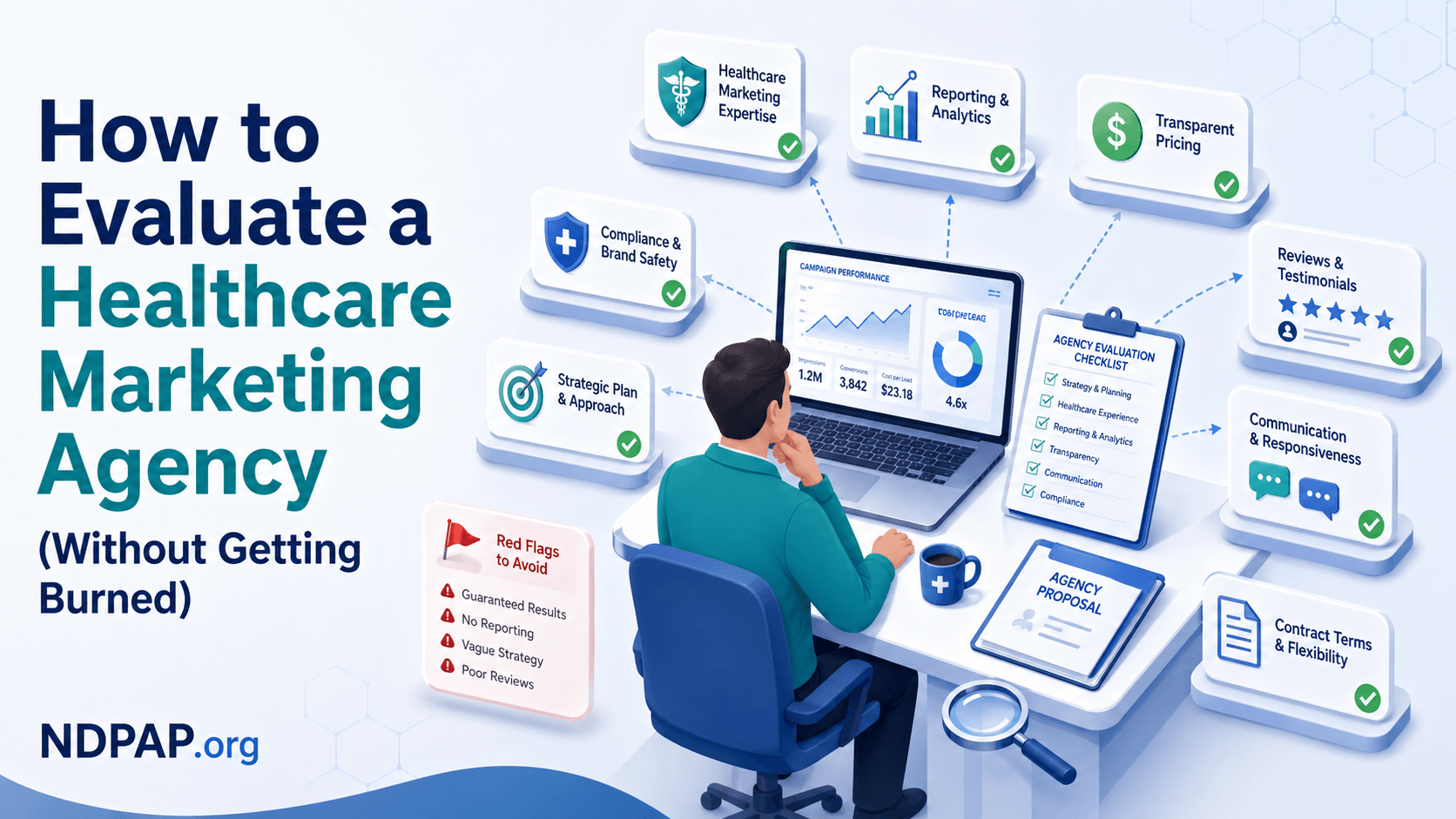
- The 10 Questions to Ask Before Signing a Contract
- Red Flags That Should Kill the Deal
- Green Flags That Signal a Legitimate Healthcare Partner
- Understanding Agency Pricing Models
- What a Fair Healthcare Marketing Contract Looks Like
- The Compliance Litmus Test
- In-House vs. Agency: When Each Makes Sense
- How to Measure Agency Performance
- Frequently Asked Questions
Why Most Marketing Agencies Fail in Post-Acute Care {#why-agencies-fail}
The hospice and home health marketing landscape is crowded with agencies selling services to providers. A quick Google search for "hospice marketing agency" returns pages of companies — Cardinal Digital Marketing, Hospice Care Marketing, WebFX, Craft & Communicate, Lead to Conversion, Branding Pioneers, and dozens more — all promising to grow your census.
Here's the problem: most of these agencies don't understand the regulatory, emotional, or operational realities of post-acute care.
They don't understand AKS constraints. Many agencies will propose referral incentive programs, pay-per-lead arrangements, or co-marketing deals with referral sources that could violate the Anti-Kickback Statute. If your marketing agency doesn't know what AKS stands for, they shouldn't be managing your marketing.
They don't understand HIPAA review management. Agencies that manage review responses for restaurants and dental offices will apply the same approach to your hospice reviews — potentially confirming patient relationships, referencing care details, or disclosing PHI in responses. See Online Reviews and HIPAA for Home Health and Hospice for what's at stake.
They don't understand the emotional context. Marketing hospice care is fundamentally different from marketing any other healthcare service. Families are in crisis. The decision is deeply personal. Aggressive sales tactics, pushy CTAs, and fear-based marketing copy that might work for a weight loss clinic or dental practice are inappropriate and counterproductive for hospice.
They don't understand Medicare billing. Without understanding how Medicare reimbursement works for hospice and home health, an agency can't calculate meaningful ROI, set appropriate cost-per-acquisition targets, or evaluate which marketing channels deliver actual revenue.
The result: independent agencies spend $3,000–$10,000 per month with agencies that generate vanity metrics (impressions, clicks, website traffic) but no measurable census growth — while inadvertently creating compliance exposure.
The 10 Questions to Ask Before Signing a Contract {#ten-questions}
Before you sign with any marketing agency, ask these questions. Their answers will tell you whether they understand your business:
1. "How many hospice or home health clients do you currently serve?"
You want an agency with at least 3–5 active post-acute care clients. If you're their first hospice client, you're paying for their learning curve.
2. "Can you explain how the Anti-Kickback Statute affects our marketing strategies?"
They should be able to describe the AKS, explain the "one purpose" test, and identify which safe harbors apply to common marketing activities. If they've never heard of the AKS, walk away.
3. "How do you handle HIPAA compliance in review management and patient testimonials?"
They should explain that reviews can't confirm patient relationships, that responses must use generic language, and that testimonials require specific HIPAA authorization. If they suggest responding to reviews by thanking patients for choosing your hospice, they don't understand the risk.
4. "What metrics do you use to measure success, and how do you tie them to census growth?"
Acceptable answers: cost per admission, cost per qualified lead, phone call conversion rate, census growth attributable to marketing channels. Unacceptable answers: impressions, reach, followers, "brand awareness."
5. "What is your approach to local SEO for service-area businesses?"
They should understand that hospice and home health agencies are service-area businesses (SABs) without storefront foot traffic, requiring different GBP strategies than location-based businesses. They should mention Google Business Profile optimization, citation building, and local content strategy.
6. "Do you use pay-per-lead or pay-per-referral pricing?"
If yes, ask how they handle the AKS implications. Pay-per-lead arrangements where the leads are Medicare patients could constitute payment for referrals under the AKS. A flat monthly retainer is the cleanest pricing model from a compliance perspective.
7. "Can you show me results from a hospice or home health client in a similar market to ours?"
Ask for specific metrics: how many reviews they built, what local pack rankings improved, how much census grew, what the cost per admission was. Anonymize the client if needed, but the numbers should be concrete.
8. "Who will actually work on our account day-to-day?"
Many agencies sell you with a senior strategist in the pitch meeting, then assign a junior coordinator to your account. Know who your point of contact will be, their experience level, and their caseload (how many clients they manage).
9. "What happens if we want to leave? What do we keep?"
You should own your Google Business Profile, your website, your content, your ad accounts, and your data. Some agencies build on proprietary platforms or hold your GBP access hostage. Clarify ownership upfront.
10. "How do you stay current on healthcare marketing regulations?"
Look for evidence of ongoing education: compliance training, healthcare marketing conferences (HCMA, SHSMD), subscriptions to Hospice News or Home Health Care News, relationships with healthcare compliance attorneys.
Red Flags That Should Kill the Deal {#red-flags}
| Red Flag | Why It Matters | |----------|---------------| | "We guarantee first-page Google rankings" | No agency can guarantee Google rankings. Google explicitly warns against agencies that make this claim. | | They can't explain AKS or HIPAA | If they don't know the regulatory landscape, they'll create compliance exposure. | | Long-term contracts with no out clause | Reputable agencies earn your business month-to-month. 12-month minimum contracts with no performance-based exit are a sign the agency expects you to be dissatisfied. | | They own your GBP or website | You should always own your digital assets. An agency that controls your Google Business Profile login can hold your listing hostage. | | Pay-per-lead pricing with no compliance discussion | This pricing model may violate the AKS when leads are Medicare patients. If the agency hasn't considered this, they're not healthcare-savvy. | | They recommend review gating | Asking satisfied patients to post reviews while routing unsatisfied patients to internal feedback violates FTC guidelines and potentially HIPAA. | | No healthcare clients in their portfolio | Post-acute care marketing requires specialized knowledge. A generalist agency will waste your budget learning on your dime. | | They promise specific lead volumes without knowing your market | Lead volume depends on market size, competition, and budget. Promises without market analysis are fabricated. | | They suggest "aggressive" referral source outreach without compliance guardrails | This indicates they don't understand the AKS implications of referral-source marketing. | | They can't describe their reporting methodology | If they can't explain how they'll track and report performance, they can't demonstrate ROI. |
Green Flags That Signal a Legitimate Healthcare Partner {#green-flags}
| Green Flag | Why It Matters | |-----------|---------------| | 5+ active hospice or home health clients | Proven experience in your specific industry | | They bring up compliance before you do | Compliance awareness signals healthcare expertise | | Month-to-month or quarterly contracts available | Confidence in their ability to deliver results | | You own all digital assets and accounts | Respects your business independence | | They explain cost per admission, not just cost per click | Understands what actually matters to your business | | They have a dedicated healthcare team | Not cross-staffing between restaurant clients and your hospice account | | They reference specific CMS, HIPAA, or AKS requirements | Knowledge depth beyond surface-level marketing | | They recommend starting with an audit before proposing solutions | Data-driven approach rather than one-size-fits-all | | They can name your competitors and their digital positioning | Have done their homework on your market | | Client references from agencies your size | Relevant experience, not just enterprise clients |
Understanding Agency Pricing Models {#pricing-models}
According to Healthcare Success's 2026 healthcare marketing agency pricing guide and InfluenceFlow's 2026 digital marketing pricing guide, here's what to expect:
| Pricing Model | Typical Range | Pros | Cons | AKS Risk | |--------------|-------------|------|------|----------| | Monthly retainer | $2,500–$15,000/month | Predictable costs, comprehensive service, aligned incentives | Higher upfront commitment | Low — fee not tied to referrals | | Percentage of ad spend | 15–25% of spend | Scales with investment, agency incentivized to manage spend well | Agency may encourage higher spend; doesn't account for organic work | Low — fee tied to spend, not referrals | | Project-based | $5,000–$50,000 per project | Clear scope, defined deliverables, good for one-time needs | No ongoing optimization, misses continuous improvement | Low | | Pay-per-lead | $30–$150 per lead | Pay only for results, low risk to start | Agency may send low-quality leads; potential AKS issue if leads are Medicare patients | Moderate to High — payment tied to referral activity | | Revenue share | 10–30% of attributed revenue | True alignment of incentives | Complex tracking, potential AKS issues, agency may prioritize volume over quality | High — compensation directly tied to patient revenue |
The recommended model for post-acute agencies: Monthly retainer with clear deliverables and performance benchmarks. This provides predictable costs, avoids AKS complications, and creates accountability through defined metrics without tying compensation to referral volume.
Healthcare premium: Healthcare agencies charge 20–30% more than generalist agencies due to HIPAA compliance overhead, regulatory knowledge requirements, and specialized content creation. This premium is worth paying — a general agency charging $3,000/month will likely cost you more in the long run through compliance exposure and ineffective strategies than a healthcare specialist charging $4,000/month.
What a Fair Healthcare Marketing Contract Looks Like {#fair-contract}
Contract length: 3–6 months initial term with month-to-month renewal. Some agencies require 6-month minimums for SEO work (because results take time), which is reasonable. Twelve-month minimums with no exit provisions are not.
Scope of work: Clearly defined deliverables, frequencies, and responsibilities. For example: "Agency will publish 4 Google Business Profile posts per month, respond to all new reviews within 48 hours, create 2 blog posts per month, and manage Google Ads with a monthly spend of $2,000."
Performance metrics: Defined KPIs with monthly reporting. At minimum: leads generated (by channel), cost per lead, website traffic (organic and paid), review count and rating, local pack ranking for target keywords.
Ownership clause: Explicit statement that you own all digital assets: Google Business Profile, Google Ads account, website domain, website content, analytics data, and creative assets.
Termination clause: 30-day written notice to terminate, with a clear transition plan. The agency should provide all login credentials, export all data, and facilitate transition to in-house management or a new agency.
Compliance clause: Statement that the agency will not engage in marketing activities that violate HIPAA, AKS, or FTC regulations, and will consult with your compliance officer or counsel before implementing any activity that involves interaction with referral sources or patient data.
The Compliance Litmus Test {#compliance-test}
Before signing with any agency, present these three scenarios and evaluate their responses:
Scenario 1: "A patient's family member left a negative review on Google saying the nursing staff was unresponsive during their mother's final days. How would you respond?"
Good answer: "We would respond within 24 hours with a generic, empathetic message that doesn't confirm the person was a patient. Something like: 'We take all feedback seriously and are committed to providing compassionate care to every family we serve. We'd welcome the opportunity to discuss your concerns directly — please contact our office at [phone number].' We would never reference the patient, the diagnosis, or the specific care details."
Bad answer: "We'd respond by explaining that the nursing team was short-staffed that week but provided excellent care" or "We'd ask the reviewer to take the review down."
Scenario 2: "We want to grow referrals from a local hospital system. What marketing strategies would you recommend?"
Good answer: "We'd recommend educational outreach — hosting in-services on hospice eligibility criteria for discharge planning staff, creating clinical reference materials, and building a clinical liaison program with your nursing team. All of these fall within AKS safe harbors as legitimate educational activities. We'd avoid anything that could be construed as providing value in exchange for referrals, like paid meals, gifts, or sponsorships tied to referral expectations."
Bad answer: "Let's create a referral incentive program" or "We'll buy lunch for the discharge planners every week."
Scenario 3: "We want to build our Google reviews from 5 to 50. How would you do it?"
Good answer: "We'd implement a multi-channel approach using HIPAA-compliant methods: in-person asks with generic print cards, a review link on your website, inclusion in community newsletter outreach, and staff advocacy. We'd never use patient records to generate review request lists or send automated review requests that confirm someone is a patient."
Bad answer: "We'll set up an automated email drip to all your patients after discharge asking them to leave a review."
In-House vs. Agency: When Each Makes Sense {#inhouse-vs-agency}
| Activity | Better In-House | Better With Agency | |----------|----------------|-------------------| | Google Business Profile management | ✓ (staff knows the agency, can post authentic content) | When no staff time available | | Review response | ✓ (in-house staff understands HIPAA context better) | When review volume is high and response time is lagging | | Community outreach and events | ✓ (requires local relationships and authentic presence) | Agency can help with event planning and collateral | | Google Ads management | When spend is < $1,000/month and expertise exists internally | ✓ (requires technical expertise and ongoing optimization) | | SEO strategy and execution | When budget is very limited (DIY basics) | ✓ (requires specialized knowledge and sustained effort) | | Content creation | ✓ (if you have a clinical team member who can write) | ✓ (for polished, SEO-optimized content at scale) | | Website design and development | — | ✓ (almost always requires professional development) | | Brand strategy | — | ✓ (outside perspective and strategic expertise) |
The hybrid approach works best for most independent agencies: handle GBP management, review responses, and community outreach in-house (where local knowledge and compliance awareness matter most), and outsource SEO, Google Ads, and content creation to a healthcare-specialized agency (where technical expertise drives results).
How to Measure Agency Performance {#measuring-performance}
Hold your agency accountable with these monthly performance metrics:
| Metric | How to Measure | What "Good" Looks Like | |--------|---------------|----------------------| | Cost per qualified lead | Total marketing spend ÷ qualified leads (phone calls + form fills) | Under $80 for local hospice markets | | Cost per admission | Total marketing spend ÷ new admissions attributed to marketing | Under $400 | | Google review growth | Net new reviews per month | 2–4 per month (steady growth) | | Local pack ranking | Position for target keywords ("hospice near me," "hospice [city]") | Top 3 for primary market | | Organic traffic growth | Month-over-month and year-over-year unique visitors from organic search | 15–20% year-over-year growth | | Conversion rate | Leads ÷ website visitors | 3%+ | | Phone call volume | Call tracking data from marketing channels | Increasing month-over-month | | Census growth | Total census change correlated with marketing launch | Measurable within 6–12 months |
Require monthly reporting. Any agency worth its retainer should provide a monthly report that includes these metrics, trend analysis, and recommendations for the coming month. If you have to chase your agency for reports, that's a red flag.
Give it time — but not too much. SEO and content marketing take 6–12 months to show meaningful organic results. Google Ads should produce measurable leads within 30–60 days. Review building should show steady growth within 90 days. If an agency can't demonstrate any measurable improvement after 6 months, it's time to evaluate alternatives.
Frequently Asked Questions {#faq}
How much should I expect to pay a healthcare marketing agency?
For an independent hospice or home health agency, a reasonable monthly investment ranges from $2,500 to $8,000 for a comprehensive digital marketing program (SEO, Google Ads management, GBP optimization, content creation, and reporting). This typically does not include Google Ads spend, which should be budgeted separately at $1,000–$5,000/month depending on market size. Agencies charging less than $2,000/month for "comprehensive" services are either cutting corners or using junior staff with minimal oversight.
Can I just hire someone in-house instead of using an agency?
For agencies with $5M+ in revenue, a dedicated marketing coordinator at $45,000–$65,000/year can handle GBP management, review responses, social media, community outreach, and basic content creation. However, you'll still need agency support or freelance specialists for technical SEO, Google Ads management, and website development. The economics favor a hybrid approach: in-house coordinator for daily marketing operations, agency or specialist for technical execution.
What if my agency suggests strategies I've read are AKS violations?
Push back immediately and cite the specific concern. If the agency dismisses your concern or doesn't know what the AKS is, that's a termination-level red flag. A legitimate healthcare marketing agency should welcome compliance discussions — it's evidence that you're a sophisticated client who values doing things right.
Should I require my agency to sign a BAA (Business Associate Agreement)?
If the agency will have access to any patient information — patient names, contact information from clinical records, patient satisfaction surveys — a BAA is required under HIPAA. If the agency only works with publicly available information (Google reviews, website analytics, ad platforms) and never accesses patient records, a BAA may not be technically required but is still best practice to formalize data handling expectations.
Sources
- Healthcare Success: Healthcare Marketing Agency Cost — 2026 Pricing Guide
- InfluenceFlow: Digital Marketing Agency Pricing Guide 2026
- PricingLink: How Much to Charge for Healthcare Marketing Services
- The Home Health Consultant: Marketing Laws and Regulations
- Cardinal Digital Marketing: Top Hospice Marketing Trends 2025
- Hospice News: Hospices Refocus on Legal Compliance in Marketing
- Forvis Mazars: Benchmarking & KPIs in Home Health & Hospice 2025
- DOJO AI: Agency Pricing Models — Fixed Fee vs. Percentage vs. Performance
- OIG: Safe Harbor Regulations
- Anti-Kickback Statute: 42 U.S.C. § 1320a-7b
This article is for educational purposes only and does not constitute legal advice. Consult a healthcare compliance attorney for guidance specific to your agency's situation.
**Before you hire a marketing agency, make sure you've clai
med your free NDPAP listing.** It's one of the highest-ROI marketing activities available — zero cost, immediate visibility in a trusted post-acute care directory, and no agency needed to set it up. Claim your NDPAP listing →