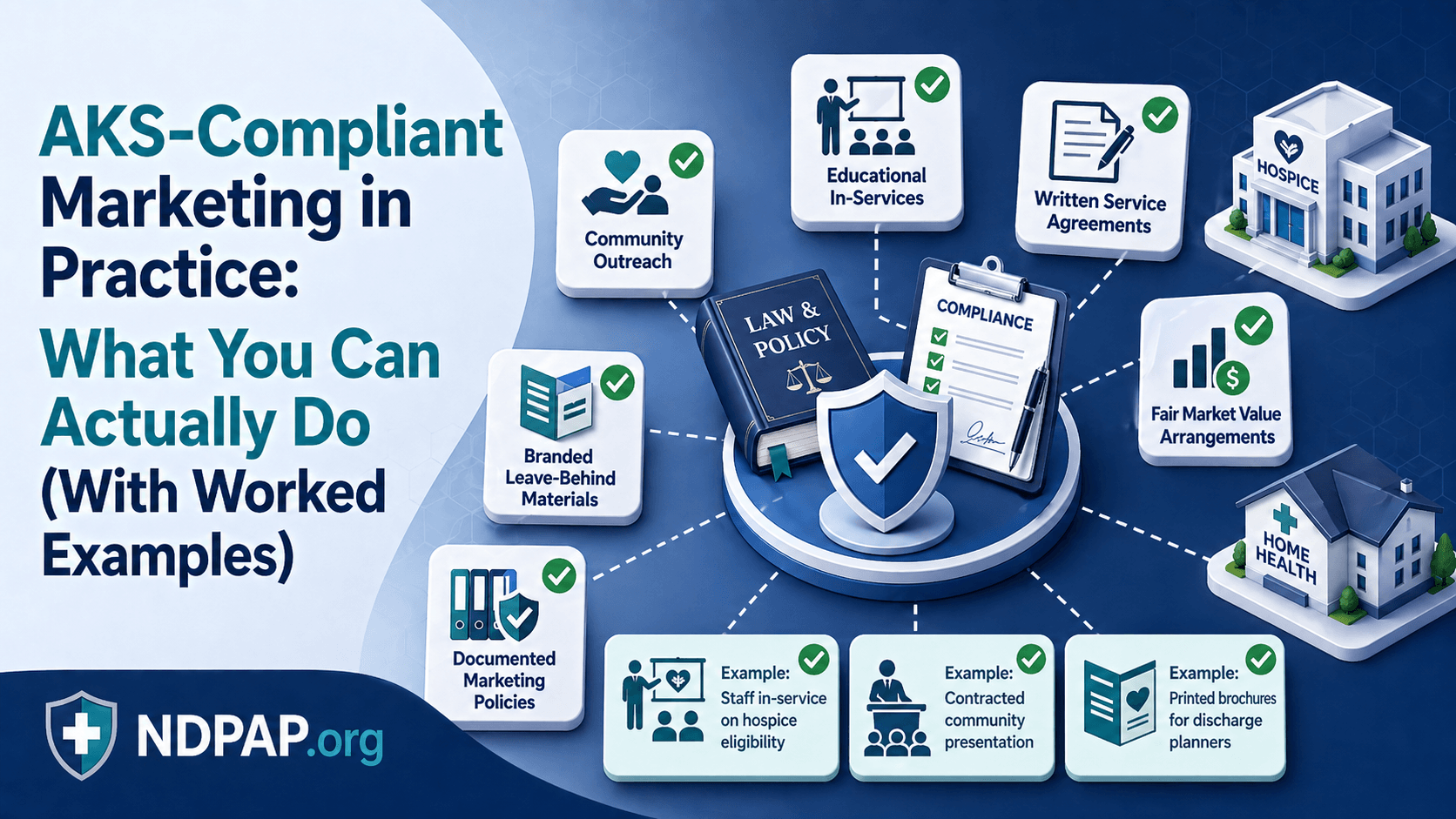
TL;DR: The previous article explained what the Anti-Kickback Statute prohibits. This one shows you what it allows — with specific, worked examples that hospice and home health operators can use as a practical playbook. From community education events to digital advertising to referral source meetings, every example is structured to show the compliant version alongside the version that crosses the line. The goal is to replace compliance anxiety with compliance confidence: know where the line is, and build your growth strategy right up to it.
Table of Contents
- The Compliance Confidence Problem
- How to Read These Examples
- Example 1: Community Education Events
- Example 2: Referral Source Meetings
- Example 3: Marketing Employee Compensation
- Example 4: Digital Advertising and SEO
- Example 5: Directory Listings and Online Profiles
- Example 6: Content Marketing (Blog, Social Media, Email)
- Example 7: Medical Director Arrangements
- Example 8: Gifts to Patients and Families
- Example 9: Co-Marketing With Other Providers
- Example 10: Hiring a Marketing Agency or Consultant
- The Compliance Documentation Checklist
- Frequently Asked Questions
The Compliance Confidence Problem {#compliance-confidence}
In our conversations with hospice and home health operators, the most common response to learning about the Anti-Kickback Statute isn't "I didn't know I couldn't do that." It's "I'm afraid to do anything."
This is the compliance confidence problem. The AKS is broad, the penalties are severe, and the enforcement environment in 2025–2026 is the most aggressive the hospice industry has ever seen. The natural reaction is to pull back from all marketing activity — which leaves your agency invisible to the families who need you.
That's the wrong response. The AKS doesn't prohibit marketing. It prohibits a specific financial arrangement: paying for referrals. Understanding the difference — through concrete examples — is how you move from fear to informed action.
This article is a companion to What the Anti-Kickback Statute Actually Prohibits in Hospice and Home Health Marketing. Read that article first for the statutory framework. This one is the practical playbook.
How to Read These Examples {#how-to-read}
Each example follows the same format:
The scenario describes a common marketing activity that hospice and home health agencies face.
The compliant version shows how to structure the activity within AKS boundaries.
The non-compliant version shows how the same activity, with small changes, crosses the line.
Why the line exists explains the specific AKS principle that separates the two.
These examples are educational illustrations, not legal advice. Your specific circumstances may differ, and you should consult a healthcare compliance attorney before implementing any new marketing arrangement. That said, the principles are well-established and the examples are based on published OIG guidance, enforcement patterns, and legal analysis from healthcare law firms.
Example 1: Community Education Events {#example-1}
The scenario: Your agency wants to host educational seminars at senior centers, churches, and community organizations to raise awareness about hospice and home health services in your area.
Compliant Version
Your agency hosts a free "Understanding the Medicare Hospice Benefit" seminar at a local senior center. The presentation is educational: it explains what hospice is, what Medicare covers, how to qualify, and what families should expect. Your agency is identified as the host, but the content is not a sales pitch. You provide printed materials from the Hospice Foundation of America and your own informational brochure with your contact information. No attendee information is collected without consent. Refreshments (coffee and cookies) are provided for attendees — they are the audience, not referral sources.
Non-Compliant Version
Same seminar, but this time you invite local physicians and discharge planners as the primary audience. You serve a catered lunch ($25/plate). After the presentation, your marketing director meets individually with each clinician to discuss "how we can work together." Your agency tracks which clinicians attend and correlates attendance with subsequent referral volume.
Why the Line Exists
The compliant version is community education — a legitimate, non-referral activity. The non-compliant version provides something of value (a catered meal) to potential referral sources and links the event to referral expectations. Under the AKS, the meal to clinicians is remuneration, and the tracking of attendance-to-referral correlation demonstrates referral intent.
The key distinction: Who is the audience? If the audience is the public (families, patients, caregivers), the event is community education. If the primary audience is people in a position to refer patients to your agency, every element of the event — especially anything of value you provide — is scrutinized under the AKS.
Example 2: Referral Source Meetings {#example-2}
The scenario: Your community liaison wants to meet with hospital discharge planners and physician offices to introduce your services and build relationships.
Compliant Version
Your liaison schedules a 15-minute meeting with a discharge planning department. They bring an informational packet: your agency's service area map, clinical capabilities, response time commitments, quality scores from Medicare Care Compare, and a direct phone number for referrals. The conversation focuses on your clinical capabilities and how your agency can support the hospital's discharge planning needs. Nothing of monetary value is exchanged. The meeting is documented in your CRM as a relationship-building activity.
Non-Compliant Version
Same meeting, but your liaison brings a $50 gift basket "as a thank you for considering us." Or they bring lunch for the entire nursing station. Or they offer to provide a free in-service training for the hospital's staff — a service that would normally cost the hospital money — with the implicit understanding that the training is connected to an expectation of referrals.
Why the Line Exists
Meeting with referral sources is standard industry practice and is not prohibited. Providing anything of value to referral sources in connection with the expectation of referrals is prohibited. According to Holland & Hart's analysis of marketing traps, even small gifts create AKS exposure because the statute has no de minimis exception for remuneration to referral sources. (Note: the $15/$75 nominal value exception applies only to gifts to patients/beneficiaries, not to referral sources.)
The key distinction: You can share information. You cannot share items of value.
Example 3: Marketing Employee Compensation {#example-3}
The scenario: You're hiring a community liaison (marketing representative) and need to structure their compensation.
Compliant Version
The liaison is a W-2 employee paid a fixed annual salary of $65,000. They receive a quarterly bonus based on activity metrics: number of facility visits completed, number of community events hosted, number of educational materials distributed, and satisfaction scores from referral source surveys. None of the bonus criteria are tied to admission volume, referral count, or revenue generated.
Non-Compliant Version
Same role, but the compensation is $40,000 base salary plus $200 per admission. Or $40,000 base plus a "performance bonus" calculated as a percentage of revenue from patients admitted through the liaison's referral sources.
Why the Line Exists
Under the bona fide employee safe harbor, employers can compensate employees under various structures. However, OIG has repeatedly cautioned that compensation heavily weighted toward referral volume raises serious compliance concerns — even within the employee safe harbor. Per-admission bonuses for marketing staff are the single most common AKS compensation violation in hospice, according to Hospice News reporting on marketing compensation risks.
The key distinction: Pay for activities (visits, events, outreach), not for outcomes (admissions, referrals, revenue).
Example 4: Digital Advertising and SEO {#example-4}
The scenario: Your agency wants to run Google Ads and invest in search engine optimization to attract families searching for hospice or home health care.
Compliant Version
You hire a marketing agency on a flat monthly retainer ($2,000/month) to manage Google Ads campaigns targeting keywords like "hospice care in [city]" and "home health near me." You also pay them to optimize your website for local search (creating service area pages, improving page speed, adding schema markup). The marketing agency is paid the same amount regardless of how many families call or how many patients are admitted. The agency is paid for advertising and optimization services, not for referrals.
Non-Compliant Version
You hire a "lead generation" company that charges you $500 per patient admitted. They run ads, answer calls from families, and route "qualified leads" to your intake team. Their compensation is directly tied to the number of patients you admit from their leads.
Why the Line Exists
The Seventh Circuit confirmed in 2025 that payments to marketers and advertisers for ordinary advertising activities — where the marketer doesn't actually refer patients — don't violate the AKS. The violation occurs when the marketing company's compensation is tied to the volume or value of patients they route to your agency. At that point, the "marketing company" is functionally a referral source being paid per referral.
The key distinction: Pay for marketing services at a flat rate. Never pay per lead, per referral, or per admission.
Example 5: Directory Listings and Online Profiles {#example-5}
The scenario: Your agency wants to be listed on healthcare directories like NDPAP, Healthgrades, Caring.com, and Medicare Care Compare.
Compliant Version
You claim and optimize your profiles on NDPAP, Healthgrades, Caring.com, and Medicare Care Compare. You pay any applicable listing fees (some directories are free, some charge for enhanced profiles). The directory provides information to families; families contact you directly. The directory doesn't receive any payment from you based on how many families call or how many patients you admit.
Non-Compliant Version
You partner with a "patient placement service" that charges you a referral fee for each patient they place with your agency. The service advertises itself as a directory, but its business model is per-referral compensation. They screen families, recommend your agency over others, and collect a fee for each placement.
Why the Line Exists
Directory listings are advertising — you're paying for visibility, not for referrals. Patient placement services that charge per-referral fees are referral sources being paid for referrals. The distinction isn't the technology or the label — it's the compensation structure.
The key distinction: Paying for a listing (flat fee, subscription) is advertising. Paying per patient is a kickback.
Example 6: Content Marketing (Blog, Social Media, Email) {#example-6}
The scenario: Your agency wants to publish blog posts, maintain a social media presence, and send email newsletters to referral sources and families.
Compliant Version
Your agency publishes blog posts on topics like "What to Expect During the First Hospice Visit" and "How Medicare Covers Home Health Services." You maintain a Facebook page where you share community events, team spotlights, and educational content. You send a monthly email newsletter to families on your mailing list (who opted in) with helpful caregiving tips and updates about your services. You send a separate quarterly newsletter to referral sources with clinical updates, quality metrics, and educational content. None of this content is conditioned on referrals, and no referral source receives anything of value beyond the information itself.
Non-Compliant Version
Same newsletters, but you include a gift card offer: "Refer a patient this month and receive a $25 Starbucks gift card." Or you create a "Referral Rewards Program" that provides escalating benefits to physicians or facilities based on referral volume.
Why the Line Exists
Content marketing is information sharing — a legitimate marketing activity with no remuneration flowing to referral sources. Referral reward programs are textbook kickback arrangements, regardless of how they're branded. The newsletter content is fine; the incentive structure attached to it is the violation.
The key distinction: Content is compliant. Incentives for referrals are not.
Example 7: Medical Director Arrangements {#example-7}
The scenario: You need a medical director for your hospice agency. The physician you want to hire also has a practice that refers patients to hospice agencies.
Compliant Version
You hire Dr. Smith as your medical director under a written agreement that specifies the duties (attending IDT meetings, reviewing plans of care, providing clinical oversight, being available for consultations). The compensation is $X per hour for documented time spent on medical director duties. The hourly rate was determined by a fair market value analysis (FMV study or comparable rate survey). Dr. Smith also refers patients to your agency when clinically appropriate — but there is no separate compensation for referrals, and the medical director compensation doesn't increase when referral volume increases.
Non-Compliant Version
Same arrangement, but Dr. Smith is paid $150,000 per year — well above fair market value for the documented hours of medical director work. The excess compensation is effectively a payment for the 40+ patients per year Dr. Smith refers to your agency. Or: Dr. Smith's compensation includes a "quality bonus" that is calculated based on the number of patients he certifies for hospice.
Why the Line Exists
Medical director arrangements are specifically identified by OIG as a high-risk area for hospice agencies because the physician occupies a dual role: clinical oversight and potential referral source. The arrangement must reflect genuine fair market value for actual medical director services. When compensation exceeds FMV or is tied to referral metrics, OIG interprets the excess as remuneration for referrals. According to Reinhart Law's analysis, these arrangements receive particular scrutiny because the physician's referral and certification roles create an inherent conflict of interest.
The key distinction: Pay fair market value for documented medical director work. Never pay for referrals disguised as medical director compensation.
Example 8: Gifts to Patients and Families {#example-8}
The scenario: You want to provide comfort items or gifts to patients and their families during care or bereavement.
Compliant Version
Your agency provides patients with a comfort kit upon admission (lotion, lip balm, socks — retail value under $15). During the holidays, you send a bereavement card and a small candle (retail value under $15) to families who lost a loved one in the past year. Your annual per-patient gift total stays under $75.
These gifts are permitted under OIG's nominal value policy, which allows gifts to Medicare and Medicaid beneficiaries valued at no more than $15 per item and $75 per patient annually, as long as the gifts are not cash or cash equivalents and are not offered to influence provider selection.
Non-Compliant Version
Your agency gives patients a $50 gift card to a local restaurant upon admission. Or you provide families with a $100 "welcome package" that includes gift cards. Or you offer patients free medical equipment (beyond what's covered by their hospice benefit) as an incentive to choose your agency.
Why the Line Exists
The beneficiary inducement statute prohibits offering anything of value to patients or families if it's likely to influence their choice of provider. The nominal value exception ($15/$75) creates a safe space for genuine comfort gestures. Cash and cash equivalents (gift cards) are never permitted under this exception, regardless of value. The gifts must be genuine expressions of care, not recruitment tools.
The key distinction: Small, in-kind comfort items are fine. Cash equivalents and high-value items intended to attract patients are prohibited.
Example 9: Co-Marketing With Other Providers {#example-9}
The scenario: A local DME company wants to co-sponsor a community health fair with your hospice agency.
Compliant Version
Both organizations split the cost of the health fair 50/50. The event is educational and open to the public. Both agencies have information tables. There is no agreement — explicit or implicit — that the DME company will refer patients to your hospice or vice versa. The co-sponsorship is a shared marketing expense for a community event, documented with a written cost-sharing agreement.
Non-Compliant Version
Same health fair, but you've also agreed that your agency will exclusively recommend this DME company to your hospice patients. Or the DME company provides the event for free (absorbing your share of costs) with the understanding that you'll direct your patients to them for equipment needs.
Why the Line Exists
Co-sponsoring a community event is a shared advertising expense — legitimate and common. Cross-referral arrangements where one party provides something of value (absorbing event costs, providing free services) in exchange for patient referrals are classic AKS violations.
The key distinction: Shared costs with no referral expectations are fine. Subsidized costs with referral expectations are not.
Example 10: Hiring a Marketing Agency or Consultant {#example-10}
The scenario: You want to hire an external marketing agency to help grow your census.
Compliant Version
You contract with a marketing agency under a written agreement. The scope of work specifies deliverables: website redesign, SEO optimization, Google Ads management, social media content creation, print materials, and monthly reporting. The agency is paid a flat monthly retainer or project-based fee. The fee was determined to be fair market value for the services described. The contract explicitly states that compensation is not based on referral volume, admission count, or revenue generated.
Non-Compliant Version
Same agency, but the contract includes a "performance bonus" of $300 per new admission generated through the agency's efforts. Or the agency is paid a percentage of revenue from patients acquired through their marketing.
Why the Line Exists
Under the personal services safe harbor, payments to contractors are protected when the arrangement is in writing, compensation is set in advance, reflects fair market value, and doesn't vary with referral volume. Per-admission or revenue-share compensation structures for marketing agencies fail the safe harbor test because they tie compensation to the volume or value of business generated.
The key distinction: Flat fees for defined marketing services are compliant. Per-admission or revenue-share fees are not.
The Compliance Documentation Checklist {#documentation-checklist}
Every marketing arrangement should be documented. If it's not in writing, it's a risk. Here's what to document:
For Every Marketing Arrangement
- Written agreement specifying the services to be performed
- Compensation terms documented in advance (before services begin)
- Fair market value analysis or comparable rate documentation
- Confirmation that compensation doesn't vary with referral volume
- Annual compliance training records for all marketing staff
- CRM or log entries for referral source meetings (date, attendees, topics discussed)
For Employee Compensation
- Written job description with activity-based performance metrics
- Compensation structure documentation showing no per-referral component
- Annual compliance training acknowledgment signed by the employee
For Contractor/Agency Arrangements
- Signed written agreement meeting personal services safe harbor requirements
- Defined scope of work with specific deliverables
- Fair market value documentation for the contracted rate
- Term of at least one year
For Medical Director Arrangements
- Written agreement specifying medical director duties
- Documentation of hours worked on medical director responsibilities
- Fair market value analysis (FMV study or comparable rate survey)
- Confirmation that compensation isn't tied to referral or certification volume
Frequently Asked Questions {#faq}
Can I take a discharge planner to lunch?
This is one of the most common questions, and the answer is conservative: it creates risk. While a single modest meal may seem trivial, the AKS has no de minimis exception for remuneration to referral sources. Many hospitals now prohibit their staff from accepting meals from vendors. The safest approach is to avoid providing meals to referral sources entirely. Build relationships through information, clinical competence, and responsiveness — not food.
Can I sponsor a booth at a hospital's charity gala?
Sponsoring a community charity event is generally permissible because you're paying for advertising (your logo and brand visibility at the event), not for referrals. The risk increases if the sponsorship comes with specific access to hospital staff, exclusive referral arrangements, or other quid pro quo expectations. Document the sponsorship as an advertising expense and ensure there's no referral component.
What if a referral source asks for something and I say no — will I lose the referral relationship?
If a referral relationship depends on you providing gifts, meals, or other inducements, it's not a relationship you can legally maintain. Relationships built on clinical quality, responsiveness, and patient outcomes are sustainable. Relationships built on gifts are liabilities. If a referral source expects inducements, that expectation is itself evidence of an AKS-problematic dynamic.
How do I know if my marketing compensation structure is compliant?
Apply this test: if all referrals stopped tomorrow, would your marketing staff's compensation change? If the answer is yes — if their pay decreases when referrals decrease — the compensation structure is tied to referral volume and creates AKS exposure. If their pay stays the same because it's based on activities (visits, events, calls) rather than outcomes (admissions, revenue), you're on solid ground.
Where does NDPAP fit in this framework?
NDPAP is a healthcare directory — an advertising platform. You pay for a listing (or claim a free listing), and families and discharge planners find you through the directory. No referral fee is charged per patient. No compensation flows to NDPAP based on how many patients contact you. This is standard advertising, clearly compliant under the AKS. Claim your listing here.
Sources
- OIG Advisory Opinions — HHS Office of Inspector General
- OIG Fraud & Abuse Laws — HHS OIG
- OIG Enforcement Actions — HHS OIG
- OIG Policy Statement: Gifts of Nominal Value — HHS OIG
- Marketing Traps for Healthcare Providers — Holland & Hart LLP
- Questionable Practices by Hospices and Nursing Homes — Reinhart Law
- Seventh Circuit Clarifies AKS and Marketing Payments — Foley & Lardner LLP
- How Sales and Marketing Compensation Can Get Hospices Into Hot Water — Hospice News
- Hospices Refocus on Legal Compliance in Marketing Practices — Hospice News
- Marketing Laws & Regulations for Home Health and Hospice — The Home Health Consultant
- OIG Advisory Opinion 25-03: Telehealth Arrangements — Hinshaw & Culbertson LLP
- Medicare Care Compare — CMS
*Compliance isn't a constraint on growth — it's the foundation of sustainable growth. The agencies that build their marketing on compliant, documented, value-driven strategies don't just avoid enforcement risk — they build referral relationships grounded in clinical quality rather than financial incentives. That's the kind of reputation that compounds. Claim your NDPAP listing — a clearly compliant way t
o put your agency in front of the families and discharge planners searching for care.*
Disclaimer: This article provides general educational information about the Anti-Kickback Statute. It is not legal advice. Consult a qualified healthcare compliance attorney for guidance on your specific arrangements and activities.