TL;DR: CMS is moving decisively toward a healthcare landscape where provider quality data is public, consumer-facing, and directly tied to payment. For hospice agencies, this means your digital presence isn't just a marketing asset — it's becoming a compliance imperative. Twenty percent of hospices failed to meet quality reporting requirements in 2025, GAO found 15% of hospices cited with serious quality issues, and the OIG collected over $143 million in hospice fraud enforcement in 2024 alone. Meanwhile, CMS is pushing transparency through Care Compare, CAHPS public reporting, and proposed consumer-friendly icons that flag non-compliant agencies. This article explains what these enforcement trends mean for your agency's digital strategy and why the line between compliance and marketing is disappearing.
Table of Contents
- The Enforcement Landscape: What's Actually Happening
- Quality Reporting: The 20% Non-Compliance Problem
- The Special Focus Program: Paused but Not Gone
- OIG Fraud Enforcement: Record Activity in 2024–2026
- The Transparency Push: Public Data as Digital Presence
- How Enforcement Creates Digital Presence Requirements
- The HQRP Payment Penalty: Quality Reporting Hits Your Revenue
- What Smart Agencies Are Doing Differently
- The Compliance-to-Marketing Pipeline
- Frequently Asked Questions
The Enforcement Landscape: What's Actually Happening {#enforcement-landscape}
CMS's approach to hospice oversight has shifted from reactive investigation to proactive surveillance. Three separate government bodies are simultaneously tightening the screws:
CMS (Centers for Medicare & Medicaid Services) is expanding quality reporting requirements, publishing more provider data publicly, and building infrastructure to identify and intervene with poor-performing agencies.
OIG (Office of Inspector General) has declared hospice fraud a top enforcement priority, deploying data analytics and inter-agency coordination to identify suspicious billing patterns, AKS violations, and fraudulent certifications.
GAO (Government Accountability Office) published a landmark report (GAO-24-106442) finding that CMS has not fully implemented its statutory oversight provisions for hospice, including overdue surveys and insufficient monitoring — effectively calling on CMS to do more, faster.
The GAO found that approximately 15% of hospices were cited with serious quality issues from 2020 through 2022, and about 10% of hospices were overdue for a survey as of May 2023 due to funding and staffing constraints at state survey agencies. These findings are driving CMS to explore more scalable oversight mechanisms — including data-driven monitoring and public transparency.
For agency operators, the takeaway is straightforward: the era of operating in regulatory obscurity is ending. Your quality data, your compliance record, and your survey history are increasingly visible to families, referral sources, and competitors. Digital presence is no longer just about marketing — it's about how you show up in a transparency-driven regulatory environment.
Quality Reporting: The 20% Non-Compliance Problem {#quality-reporting}
One of the most striking data points from CMS's FY 2026 Hospice Final Rule (CMS-1835-F) is that roughly 20% of hospices failed to meet Hospice Quality Reporting Program (HQRP) requirements in calendar year 2025. This percentage has remained stubbornly consistent across multiple reporting years.
What non-compliance means: Agencies that don't submit required quality data face a 4-percentage-point reduction in their Annual Payment Update (APU). In practical terms, if the standard payment increase is 3%, a non-compliant agency receives a -1% adjustment — a penalty that compounds every year the agency remains non-compliant.
What non-compliance signals to families: CMS has proposed adding a consumer-friendly icon on Care Compare that would flag agencies where CMS lacks sufficient quality data to assess performance. This icon would tell families: "We can't verify the quality of this hospice because they didn't report their data."
For the 20% of agencies that aren't reporting, this creates a cascading problem:
- Payment penalty — direct revenue reduction
- Transparency flag — families see the non-reporting indicator on Care Compare
- Referral risk — hospital discharge planners increasingly check Care Compare quality data when building preferred provider lists, especially in TEAM markets
- Competitive disadvantage — agencies that do report well earn visibility advantages
The message from CMS is clear: if you're not reporting quality data, you're not just non-compliant — you're invisible in the government's transparency infrastructure.
The Special Focus Program: Paused but Not Gone {#special-focus-program}
The Hospice Special Focus Program (SFP) is CMS's most ambitious attempt to identify and intensively monitor poor-performing hospice providers. Authorized by the Consolidated Appropriations Act of 2021, the SFP was designed to select agencies with patterns of serious deficiencies and subject them to more frequent surveys, corrective action requirements, and potential decertification.
What happened: CMS released its initial list of 50 hospices selected for the SFP in early 2025. Within weeks, a coalition of state hospice associations filed a lawsuit challenging the program's implementation. On February 14, 2025, CMS suspended the SFP to "further evaluate the program."
What it means: The SFP is paused, not abandoned. CMS has invested significant resources in developing the selection algorithm — which evaluates agencies based on Condition-Level Deficiencies across 11 Conditions of Participation — and the political pressure to address hospice quality concerns hasn't diminished. When the SFP resumes (and most industry analysts expect it will, in some form), the selected agencies will face intensive oversight that directly impacts their ability to operate.
The digital presence connection: The SFP algorithm uses survey deficiency data that is already partially public through CMS databases. As transparency increases, families and referral partners will have access to the same quality indicators that CMS uses to flag poor performers. Agencies that proactively publish their quality metrics, CAHPS scores, and compliance records on their own websites and profiles are building a trust advantage that will become more valuable as public reporting expands.
OIG Fraud Enforcement: Record Activity in 2024–2026 {#oig-fraud}
The OIG has made hospice fraud a stated enforcement priority, and the results are visible in the scale and aggressiveness of recent actions:
| Enforcement Action | Year | Amount / Details | |-------------------|------|-----------------| | National Health Care Fraud Takedown | 2025 | Multi-state coordinated action targeting hospice and home health fraud | | California $50M hospice fraud arrests | 2026 | 8 individuals arrested, 7 companies involved in LA County | | California $267M hospice fraud ring | 2026 | 21 suspects charged, 5 arrested, Operation Skip Trace | | Enhanced PPEO state oversight | Ongoing | Heightened surveillance in AZ, CA, NV, TX | | OIG hospice improper payments | 2024 | Hospice among top 4 categories for improper Medicare payments |
The enforcement patterns reveal two trends that affect all agencies, not just fraudulent ones:
1. Geographic concentration in high-growth markets. CMS has promised enhanced oversight for hospices in Arizona, California, Nevada, and Texas — the same states where hospice growth has been fastest. If your agency operates in these states, the regulatory microscope is closer than average.
2. Data-driven detection. The OIG is increasingly using data analytics to identify suspicious patterns — unusual growth rates, high live discharge rates, referral concentration from specific sources, and billing anomalies. According to McKnight's Home Care reporting, CMS's fraud crackdown is in full effect, using algorithmic analysis alongside traditional investigation.
What this means for legitimate agencies: The fraud enforcement wave is simultaneously a threat and an opportunity. The threat: any agency with unusual metrics — rapid census growth, high referral concentration, or above-average lengths of stay — may attract scrutiny even if operations are legitimate. The opportunity: as fraudulent providers are removed from the market, legitimate agencies inherit their patient volume and referral relationships. Agencies that can demonstrate quality, transparency, and compliance gain a competitive advantage.
The Transparency Push: Public Data as Digital Presence {#transparency-push}
CMS is steadily expanding the amount of hospice data available to the public. The implications for your digital presence are significant:
Medicare Care Compare now provides quality scores, CAHPS survey results, and provider information for every Medicare-certified hospice in the United States. Families can compare agencies side by side, filtering by location and quality metrics.
National Hospice Locator — launched in 2023 — provides the first publicly available national ranking of all hospices by quality. This tool didn't exist five years ago. Today, a family considering your agency can see exactly how your quality scores compare to every competitor in your area.
CAHPS Hospice Survey data is publicly reported and updated regularly, with quality scores ranging from 34 to 100 and a national mean of approximately 67. Your agency's CAHPS performance is visible to anyone who checks.
Proposed non-reporting icon — CMS has proposed adding a consumer-facing icon that flags hospices without sufficient quality reporting data. This would make non-compliance visible to families at the point of decision.
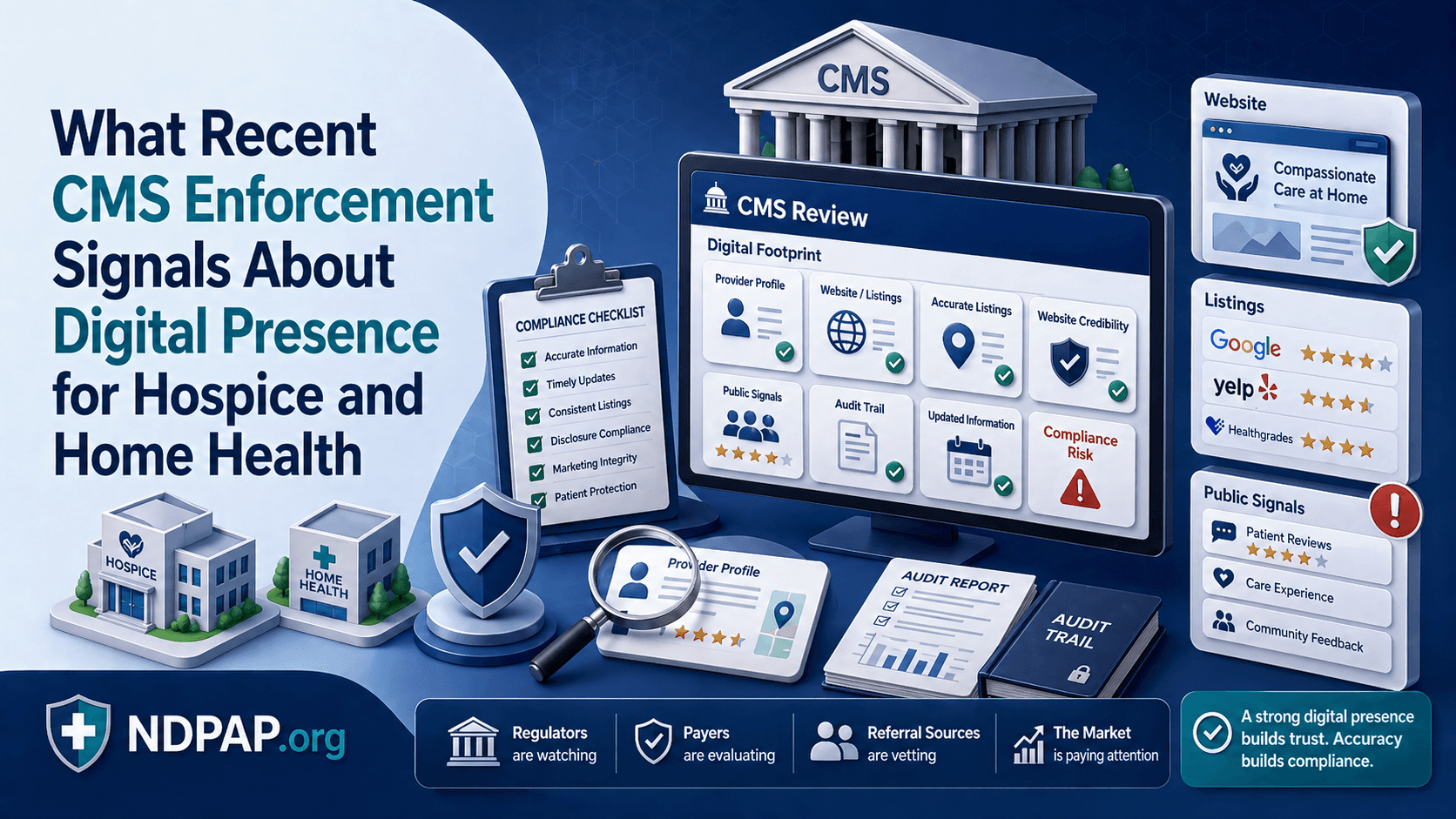
The digital presence implication: Your Care Compare profile, your CAHPS scores, and your compliance record are already part of your digital presence — whether you manage them or not. Families, discharge planners, and referral sources who search your agency name will find this government data alongside your Google reviews and website. A strong Google profile with 40 five-star reviews loses some of its impact if the same family checks Care Compare and finds a quality score of 45 or a non-reporting flag.
The agencies that treat quality reporting as part of their marketing strategy — not just a compliance checkbox — will have the most cohesive digital presence.
How Enforcement Creates Digital Presence Requirements {#enforcement-digital}
The connection between enforcement trends and digital presence requirements plays out in five specific ways:
1. Public quality data becomes your reputation. As CMS publishes more data, families have more ways to evaluate your agency before making contact. Your CAHPS scores, survey history, and quality metrics are public — they show up in Google searches alongside your reviews and website.
2. Referral partners check compliance data. Hospital discharge planners, especially in TEAM markets, are evaluating post-acute partners based on quality outcomes. An agency that can't demonstrate quality data won't survive the narrowing of preferred provider lists.
3. Fraud enforcement makes transparency a differentiator. In markets where fraudulent providers have been prosecuted, the remaining legitimate agencies benefit from demonstrating transparency. Publishing your quality scores, accreditation status, and compliance certifications on your website signals "we have nothing to hide."
4. Non-compliance creates digital visibility gaps. The 20% of hospices not meeting HQRP requirements will have incomplete Care Compare profiles, potential payment penalties, and eventually consumer-facing non-compliance flags. These gaps are effectively negative digital presence.
5. Quality data feeds SEO. Agencies that embed quality metrics, CAHPS scores, and Care Compare data into their website content create authoritative, data-rich pages that perform well in organic search. A page titled "Our Quality Scores: How [Agency Name] Compares" with real CMS data is exactly the type of E-E-A-T content that Google rewards in healthcare search results.
The HQRP Payment Penalty: Quality Reporting Hits Your Revenue {#hqrp-penalty}
The financial mechanism is simple but impactful. Under the HQRP, hospices that fail to submit required quality data receive a 4-percentage-point reduction in their Annual Payment Update.
Example: If the FY 2026 hospice payment update is 3.0%, a non-compliant agency would receive a -1.0% adjustment. For an agency with $5 million in annual Medicare revenue, the 4-percentage-point difference represents approximately $200,000 in lost revenue per year.
The required quality data submissions include:
- Hospice Item Set (HIS) data at admission and discharge
- CAHPS Hospice Survey participation
- Hospice Outcomes and Patient Evaluation (HOPE) data (phased in)
CMS has begun distributing non-compliance notifications through Medicare Administrative Contractors, placed in hospices' CASPER folders in QIES. If your agency received a notification, remediation is urgent — the payment penalty is automatic.
What Smart Agencies Are Doing Differently {#smart-agencies}
Agencies that are thriving in the current enforcement environment share several characteristics:
They treat quality reporting as a marketing input. They don't just submit HQRP data to avoid penalties — they use their quality scores in marketing materials, on their website, and in conversations with referral sources. "Our CAHPS family satisfaction score is 87, compared to the national average of 67" is a powerful differentiator.
They proactively manage their Care Compare profile. They check their Care Compare listing quarterly, ensure data accuracy, and understand how their scores compare to local competitors. They treat it like they treat their Google Business Profile — as a managed asset, not an afterthought.
They publish compliance credentials on their website. Accreditation status (CHAP, ACHC, Joint Commission), survey results, quality awards, and staff credentials are prominently displayed. This builds the E-E-A-T (Experience, Expertise, Authoritativeness, Trustworthiness) signals that Google uses to rank healthcare content.
They prepare for the SFP resumption. Even though the SFP is paused, smart agencies are reviewing the SFP algorithm to understand how they'd score, identifying any Condition-Level Deficiencies that could trigger selection, and remediating before the program restarts.
They document everything. In an enforcement-heavy environment, documentation is protection. Every educational presentation, referral interaction, marketing expenditure, and compliance training session is recorded. This documentation serves dual purposes: compliance defense and marketing content.
The Compliance-to-Marketing Pipeline {#compliance-marketing}
The most counterintuitive insight from the current enforcement landscape is that compliance work and marketing work are converging. Here's the pipeline:
| Compliance Activity | Marketing Output | |--------------------|-----------------| | Submit HQRP quality data | High CAHPS scores become website and marketing differentiators | | Maintain survey-ready compliance | "No deficiencies on last survey" becomes a trust signal | | Achieve accreditation (CHAP, ACHC) | Accreditation badge on website and GBP builds credibility | | Train staff on HIPAA/AKS compliance | Compliant review responses and marketing content | | Document quality outcomes | Data-rich content for website SEO | | Complete Care Compare profile accurately | Better visibility on government comparison tools |
This pipeline works because of a fundamental shift in how families evaluate providers. The old model was: family gets hospital recommendation → family calls agency → family makes a decision based on the intake experience. The new model is: family searches online → family checks reviews → family checks quality data → family narrows to 2–3 options → family calls top choices.
In the new model, your compliance record IS your marketing. An agency with a 90th-percentile CAHPS score, CHAP accreditation, no recent survey deficiencies, and 40 Google reviews at 4.8 stars presents an overwhelmingly strong digital presence. Every piece of that story started as a compliance or quality activity.
For more on building the specific digital components, see:
- Google Business Profile for Hospice and Home Health
- Local SEO for Post-Acute Providers
- Online Reviews and HIPAA for Home Health and Hospice
Frequently Asked Questions {#faq}
Is the Hospice Special Focus Program coming back?
Almost certainly, in some form. CMS invested heavily in developing the SFP algorithm and selection methodology. The pause was driven by legal challenges to implementation specifics, not a policy reversal. Most industry analysts expect a modified version to resume. Agencies should review the published algorithm and assess their risk profile now rather than waiting.
Will CMS eventually make survey results publicly accessible for all hospices?
The trend is clearly toward more transparency, not less. Care Compare already publishes quality scores and CAHPS data. The proposed non-reporting icon would add another layer. Full survey result publication is a logical extension of this trend, though no specific timeline has been announced.
How does fraud enforcement in California and other PPEO states affect agencies in other states?
The data analytics tools and enforcement methodologies being deployed in PPEO states (Arizona, California, Nevada, Texas) will eventually expand. Algorithmic detection of suspicious billing patterns is scalable — once CMS proves the approach in high-fraud states, the same tools can be applied nationally. All agencies should operate under the assumption that their billing patterns are being analyzed.
Should I publish my quality scores on my website even if they're average?
Yes. Publishing average scores with context ("Our family satisfaction score is 67, matching the national average — and we're working to improve") is better than publishing nothing. Absence of quality data creates suspicion. Presence of data — even average data — signals transparency and accountability. And if your scores are above average, publishing them is one of the highest-impact marketing activities you can do.
How do I check my agency's Care Compare profile?
Visit Medicare Care Compare and search for your agency by name or location. Review your quality scores, CAHPS results, and all listed information for accuracy. If you find errors, contact your MAC (Medicare Administrative Contractor) to request corrections.
Sources
- GAO-24-106442: Medicare Hospice — CMS Needs to Fully Implement Statutory Provisions
- CMS: FY 2026 Hospice Final Rule (CMS-1835-F)
- CMS: Hospice Special Focus Program
- Center for Medicare Advocacy: CMS Suspends SFP Launch
- CMS: Hospice Special Focus Program User's Guide
- Hospice News: Fighting Hospice Fraud an OIG Priority
- Hospice News: $50M California Hospice Fraud Arrests
- OIG: Hospice Enforcement Actions
- McKnight's: CMS Crackdown on Fraudulent Hospice Providers
- CMS: Hospice QRP Announcements
- CAHPS Hospice Survey: Public Reporting
- CMS: FY 2026 Mission & Priorities Document
- Hall Render: CMS Pauses SFP for CY 2025
- CHAP: Compliance Monitor June 2025
Your NDPAP listing works alongside your compliance record. When families research your agency, they check multiple sources — Google reviews, Care Com
pare, and directories like NDPAP. A claimed, optimized listing ensures that your presence is consistent, accurate, and professional across every platform families use. Claim your NDPAP listing →