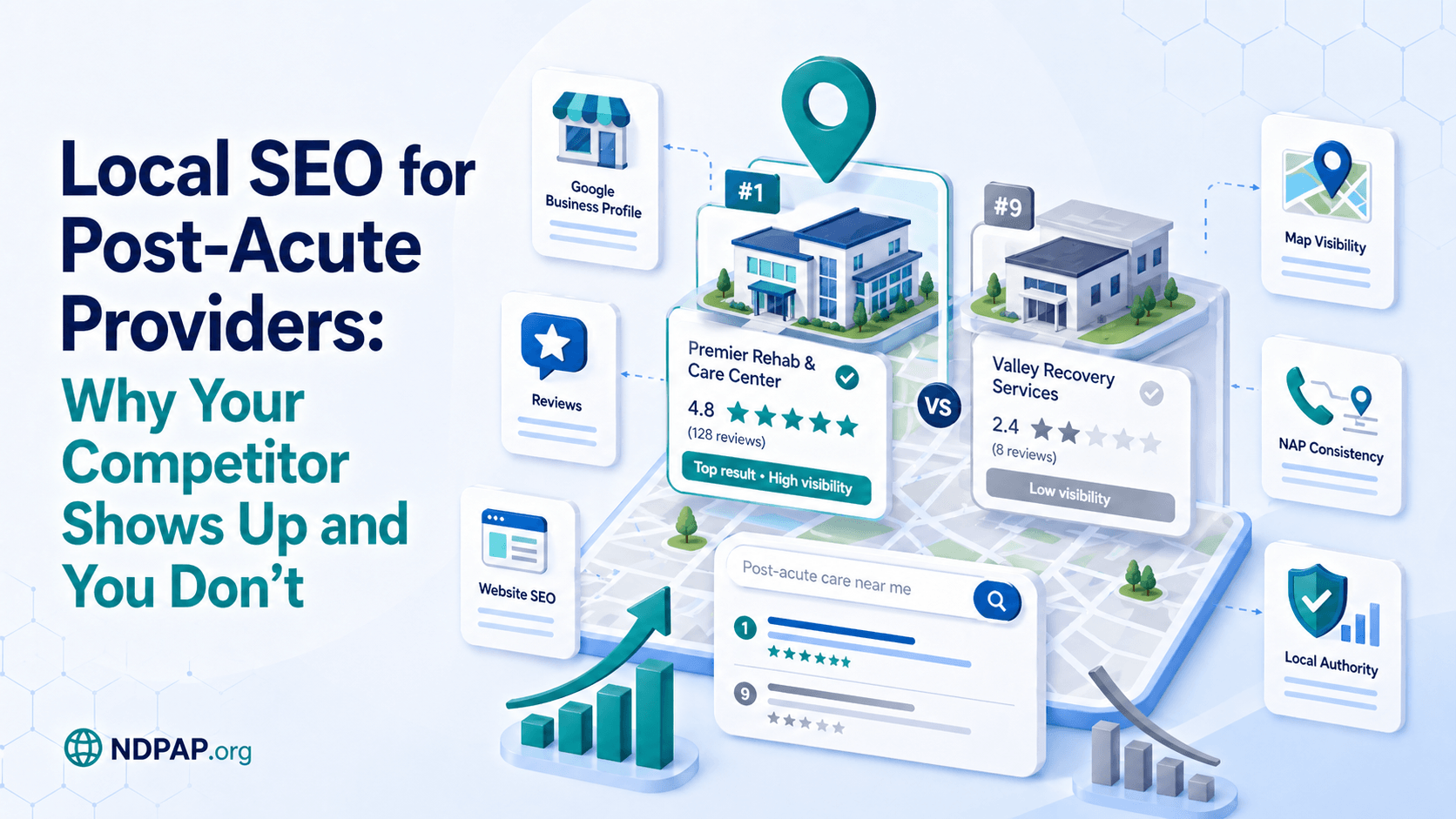
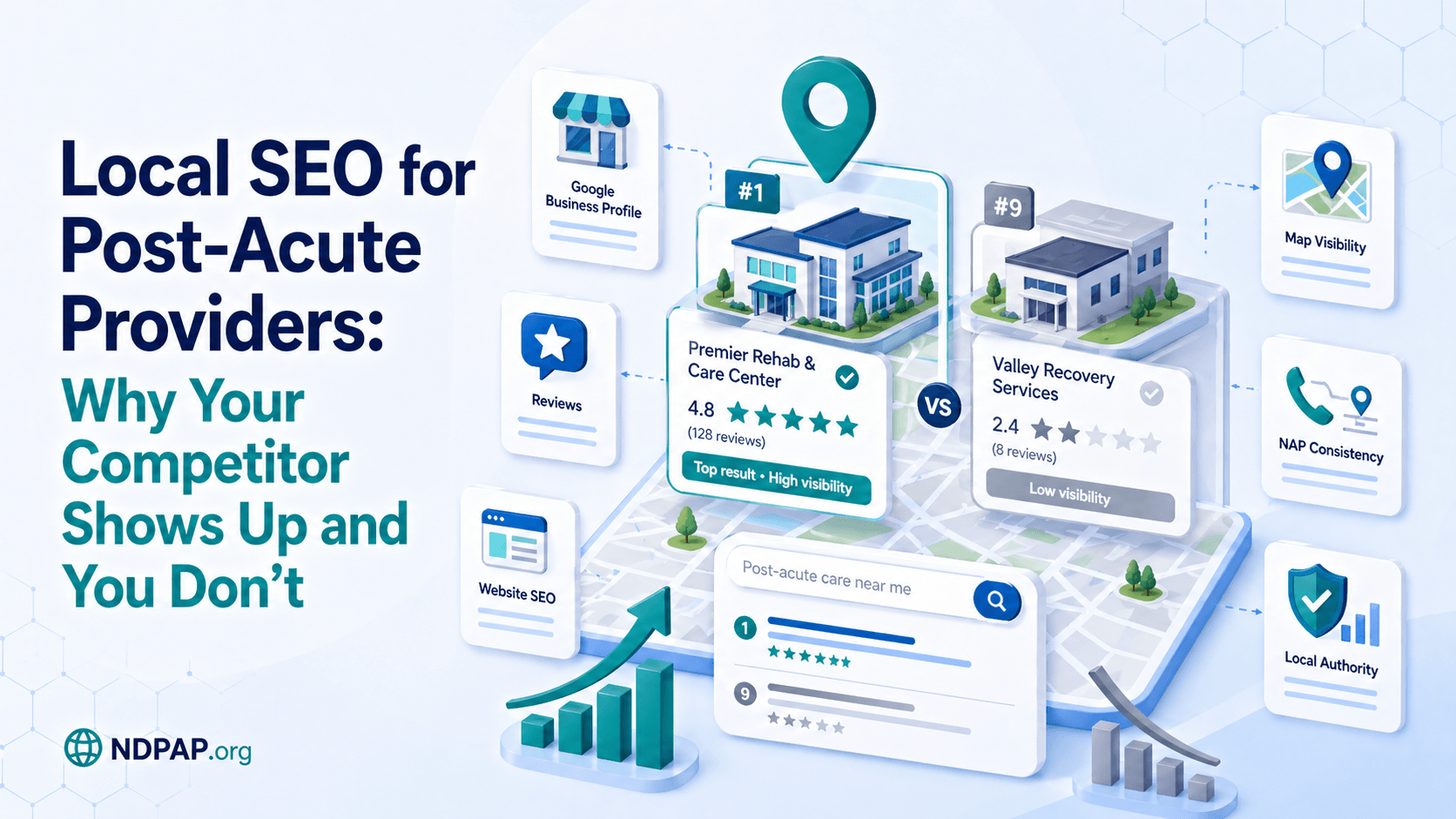
TL;DR: Local SEO is the reason one hospice agency in your metro appears in the Google map pack for every relevant search while another — with better clinical outcomes and longer community tenure — is invisible. It's not about who has the bigger marketing budget. It's about who has done the foundational work: consistent citations across healthcare directories, location-specific website content, structured data markup, and an active online presence that Google trusts enough to recommend. This article covers the complete local SEO playbook for hospice, home health, and post-acute providers — beyond the [Google Business Profile](/grow?source=article) basics covered in our previous guides.
Table of Contents
- What Local SEO Actually Is (and Isn't)
- The Three Ranking Systems You Need to Understand
- The Citation Foundation: Where You Need to Be Listed
- Building Location-Specific Website Content
- Schema Markup for Healthcare Providers
- Link Building That Actually Works for Post-Acute Care
- The Role of Medicare Care Compare in Your Visibility Strategy
- How AI Search Is Changing Local Discovery
- Measuring What Matters: Local SEO Metrics for Post-Acute
- The 90-Day Local SEO Sprint
- Frequently Asked Questions
What Local SEO Actually Is (and Isn't) {#what-local-seo-is}
Local SEO is the practice of optimizing your online presence so that your business appears in geographically relevant search results. When a family member searches "hospice care near me" or "home health in [city]," local SEO determines whether your agency is among the results they see.
It is not the same thing as general SEO. General SEO helps a website rank for broad informational queries ("what is hospice care"). Local SEO helps a specific business rank for location-specific queries ("hospice care in Phoenix"). The ranking factors, strategies, and competitive dynamics are fundamentally different.
For post-acute providers, local SEO is the highest-converting digital channel available. According to healthcare SEO research, 77% of patients begin their healthcare journey on a search engine. Among those searches, "near me" and city-specific queries drive the majority of new patient acquisition for local providers. And unlike paid advertising, local SEO produces compounding returns — the work you do today continues to generate visibility for months and years.
The previous articles in this series covered two critical pieces of the local SEO puzzle: why your agency doesn't show up on Google and how to set up your Google Business Profile. This article covers everything else: the citations, content, technical markup, link building, and measurement that separate agencies that dominate local search from those that don't appear at all.
The Three Ranking Systems You Need to Understand {#three-ranking-systems}
Google doesn't have one search results page — it has three distinct systems that display local business information, each with its own ranking factors.
1. The Local Pack (Map Pack)
The three business listings that appear with a map at the top of search results. This is the highest-visibility placement for local queries — 44% of local searchers click on a local pack result, according to local pack CTR research.
What drives Local Pack rankings: Google Business Profile completeness, proximity to the searcher, review volume and quality, NAP consistency, primary category relevance, and behavioral signals (clicks, calls, direction requests).
2. Local Organic Results
The traditional "blue link" search results that appear below the local pack. These are driven primarily by your website's content and authority.
What drives local organic rankings: Website content relevance, domain authority, on-page optimization (title tags, headers, meta descriptions), location-specific content, backlink profile, and technical health (speed, mobile-friendliness, HTTPS).
3. Google Maps
The full map interface that users access by clicking "More places" from the local pack or searching directly in Google Maps. Rankings here are heavily influenced by proximity and GBP signals.
What drives Maps rankings: Similar to the local pack, with even more weight on proximity and GBP completeness.
Why This Distinction Matters
Many agencies focus all their energy on their Google Business Profile (which primarily affects the local pack and Maps) while neglecting their website (which affects local organic results). Or they invest in website SEO without ever optimizing their GBP. You need both. The agencies that dominate local search are visible across all three systems.
The Citation Foundation: Where You Need to Be Listed {#citation-foundation}
Citations are mentions of your agency's name, address, and phone number (NAP) on third-party websites. They serve as trust signals that validate your business information and contribute to your prominence in local search. Citation signals contribute to approximately 11% of local ranking factors, according to BrightLocal's citation research.
Tier 1: Core Citations (Do These First)
These are the foundational listings that feed data to hundreds of smaller directories and that Google directly references for business verification.
| Directory | Why It Matters for Post-Acute Providers | |---|---| | Google Business Profile | The #1 local ranking factor — covered in our GBP guide | | Medicare Care Compare (medicare.gov/care-compare) | CMS's official provider directory. Discharge planners, families, and Google all reference it. Your data here must match your GBP exactly. | | Data Axle (formerly Infogroup) | Major data aggregator that feeds 100+ smaller directories | | Neustar / Localeze | Major data aggregator | | Foursquare | Major data aggregator powering Apple Maps, Uber, and others | | Yelp | Ranked as the #1 citation factor in Whitespark's survey. Even if you don't expect Yelp reviews, having an accurate profile there matters. | | Apple Maps / Apple Business Connect | Apple Maps usage nearly doubled in 2025 (from 14% to 27% of consumers), per BrightLocal's 2026 survey |
Tier 2: Healthcare-Specific Citations
These directories carry extra weight because they're niche-relevant to healthcare, which signals domain authority to Google.
| Directory | Notes | |---|---| | Healthgrades | One of the most visited healthcare directories. Ensure your agency profile is complete and accurate. | | WebMD Care Directory | High domain authority; referral source for families | | Vitals | Provider directory with review capabilities | | NDPAP (ndpap.org) | Post-acute-specific directory built for hospice, home health, and SNF providers | | Caring.com | Senior care directory with review system | | AgingCare.com | Caregiver-focused directory | | State hospice/home health association | Many state associations maintain provider directories (e.g., FHPCA in Florida, CAHSAH in California) | | State licensing board | Your licensing agency's public provider lookup must match your other listings |
Tier 3: General Business Citations
| Directory | Notes | |---|---| | Better Business Bureau (BBB) | Trust signal, especially for older demographics | | Facebook | Your business page NAP should match; increasingly used as a review platform | | LinkedIn | Company page with accurate location data | | Bing Places | Don't ignore Microsoft's search engine — it powers Alexa, Cortana, and some AI assistants | | Yellow Pages / YP.com | Still used by older searchers |
The Audit Process
Search for your agency name in quotes on Google. Document every listing you find. Compare each one against your canonical NAP (the exact version on your Google Business Profile). Fix discrepancies starting with Tier 1 and working down. This is tedious but high-impact work — businesses that achieve full NAP consistency see measurable visibility improvements within 60–90 days.
Building Location-Specific Website Content {#location-content}
If your website has a single "Services" page and a single "Contact" page, Google has very little information about where you operate. Creating location-specific content tells Google — and families — exactly which communities you serve.
Service Area Pages
For every major city or county you serve, create a dedicated page. This is the single most impactful website change most agencies can make.
What to include on each service area page:
- The city/county name in the page title, H1 heading, and URL (e.g.,
/hospice-care-phoenix-az) - A description of your services specific to that area
- The hospitals, care facilities, and communities you serve in that area
- Your response time to referrals in that area
- A unique piece of local information — a mention of a local healthcare system you partner with, a community organization you support, or a local statistic about hospice utilization
- A clear call to action (phone number, contact form)
- Schema markup with geographic coordinates
What not to do: Do not create 15 identical pages with only the city name changed. Google's algorithms detect duplicate content and will ignore — or penalize — these pages. Each page needs genuinely distinct content. If that feels like a lot of writing, start with your top three markets and expand over time. According to local SEO research, a well-built location page for a secondary market can become a top traffic source within 60–90 days of publication.
Blog Content With Local Relevance
Blog posts that reference local healthcare news, community events, or regional care statistics signal to Google that your website is a locally relevant resource. Examples:
- "Understanding hospice options in Maricopa County"
- "How [City] families are using Medicare's hospice benefit in 2026"
- "Our team at the [City] Senior Health Fair"
This content doesn't need to be long. A 500-word post with a local angle published monthly is more valuable than a 3,000-word post about generic hospice information.
Schema Markup for Healthcare Providers {#schema-markup}
Schema markup is structured data you add to your website's code that helps Google understand your business information in a machine-readable format. It doesn't change how your website looks to visitors — it changes how Google interprets your content.
Which Schema Types Matter for Post-Acute Providers
According to healthcare schema research, the most impactful schema types for healthcare providers are:
LocalBusiness (or its subtypes Hospital, MedicalClinic): Confirms your business name, address, phone number, hours, and geographic coordinates. This reinforces your GBP data and improves accuracy in "near me" searches.
MedicalOrganization: Specifies your medical specialty, certifications, accreditations, and the conditions/services you handle. Properties like hasCertification and medicalSpecialty support E-E-A-T signals that are critical for healthcare content.
Service: Describes specific services you offer (hospice care, palliative care, skilled nursing, etc.) with descriptions and service areas.
FAQPage: If your page includes a FAQ section, marking it up with FAQPage schema can generate expandable FAQ rich results in search — giving you significantly more visual real estate on the results page.
A Realistic Expectation
Controlled studies suggest that schema markup's direct impact on rankings is modest for most types. However, for healthcare providers, the indirect benefits are substantial: schema helps Google correctly categorize your business, connect your website to your GBP, and display rich results (star ratings, FAQ dropdowns) that increase click-through rates. Google's Structured Data Markup Helper can generate basic LocalBusiness schema for free — it takes 15 minutes.
Link Building That Actually Works for Post-Acute Care {#link-building}
Backlinks — links from other websites to yours — are a major factor in domain authority, which affects your local organic rankings. But for healthcare providers, link building must be conservative and credible. Google's algorithm is specifically designed to evaluate healthcare links through an E-E-A-T lens: a link from a hospital, university, or government site carries far more weight than a link from a random blog.
Link Sources That Move the Needle
Hospital and health system partnerships. If you have referral relationships with hospitals, ask whether they maintain a community resources page or partner directory. A link from a hospital website is one of the most valuable local links a post-acute provider can earn.
State and local associations. Your state hospice association, state home health association, and local chamber of commerce likely have member directories with links. These are easy to obtain and carry genuine authority.
Community organizations. Sponsoring a local health fair, Alzheimer's walk, or senior center event often comes with a link from the organization's website. These demonstrate community involvement and generate geographically relevant links.
Educational institutions. If your agency hosts nursing students, social work interns, or provides educational presentations at local colleges, the institution may link to you as a clinical partner.
Local news coverage. A story about your agency in the local newspaper or news station's website produces a high-authority local link. Consider pitching stories about community events, milestone patient count, or educational programs you offer.
What to Avoid
Do not purchase links. Do not participate in link exchange schemes. Do not hire someone offering to build you "500 backlinks for $99." Google's August 2025 spam update specifically targeted aggressive low-quality link building strategies, and healthcare websites are held to a higher standard. One penalty can undo months of work.
The Role of Medicare Care Compare in Your Visibility Strategy {#care-compare}
Medicare Care Compare is CMS's official provider comparison tool, and it plays a unique dual role in your local SEO strategy.
For Families and Discharge Planners
Care Compare displays quality measures, star ratings (based on the CAHPS Hospice Survey), and basic provider information for every Medicare-certified hospice and home health agency. Under 42 CFR § 482.43, hospitals are required to share this quality data with patients during discharge planning. Many discharge planners use Care Compare directly as part of their referral workflow.
For Google
Care Compare is a .gov domain — the highest authority signal possible. Google references CMS data when validating healthcare provider information. If your agency's name, address, or phone number on Care Compare doesn't match your GBP, Google receives conflicting signals from two authoritative sources, which undermines your ranking.
What to Do
Verify your listing at medicare.gov/care-compare. Ensure your business name, address, phone number, and services match your Google Business Profile exactly. If your Care Compare data is wrong, you'll need to correct it through CMS's provider enrollment process — it's bureaucratic, but it matters. Also monitor your quality measures and star ratings, as they increasingly appear in search results and AI recommendations.
How AI Search Is Changing Local Discovery {#ai-search}
The way families find care is evolving beyond traditional Google search. According to BrightLocal's 2026 survey, use of ChatGPT and other generative AI tools for local business recommendations grew from 6% to 45% in a single year, making AI the third most popular source of business recommendations.
What This Means for Post-Acute Providers
AI systems like Google's Gemini, ChatGPT, and others pull information from multiple sources to generate recommendations. When a family asks an AI "find hospice care near me," the AI draws from Google Business Profiles, website content, review text, directory listings, and structured data. It's essentially doing what a human researcher would do — but at scale and with a preference for consistent, well-structured information.
Agencies with complete GBPs, consistent citations, review text that mentions services and locations, and schema-marked websites are most likely to be recommended by AI systems. Agencies with sparse or inconsistent digital footprints are invisible to these systems.
The Good News
Currently, 0% of local/provider intent queries generate AI Overviews in Google Search, according to healthcare AI research from BrightEdge. Google has decided that local healthcare searches should be handled by traditional local results (maps, local pack, organic listings) rather than AI summaries. This means the local SEO fundamentals described in this article remain the primary path to visibility — AI recommendations from third-party tools are an additional channel, not a replacement.
Measuring What Matters: Local SEO Metrics for Post-Acute {#measuring}
Local SEO is measurable, but you need to track the right metrics — not vanity numbers.
Metrics That Matter
| Metric | Where to Find It | What It Tells You | |---|---|---| | GBP calls, direction requests, website clicks | Google Business Profile Insights | Direct lead generation from your profile | | Search queries that triggered your profile | GBP Insights → "How people find you" | Whether you're appearing for the right searches | | Local pack ranking for primary keywords | Google search (incognito mode, from your market) | Your visibility for family and provider searches | | Review count and average rating | Your GBP | Social proof trajectory | | Website traffic from local organic search | Google Analytics → Organic traffic filtered by city | Whether your location pages are working | | Citation accuracy score | BrightLocal, Moz Local, or manual audit | Whether your NAP is consistent across the web | | Referral source tracking | Your intake system | Whether you can attribute referrals to online channels |
Metrics That Don't Matter
Total website traffic (without geographic context), social media follower count, number of blog posts published (volume without quality), and "domain authority" as an isolated number (it's directional, not diagnostic).
A Simple Monthly Report
Track these four numbers monthly: GBP-generated phone calls, new Google reviews, local pack position for your top three keywords, and website visits to your service area pages. If all four are trending upward, your local SEO strategy is working.
The 90-Day Local SEO Sprint {#ninety-day-sprint}
Based on local SEO sprint methodology, here's a structured 90-day plan for post-acute providers.
Days 1–30: Foundation
- [ ] Optimize Google Business Profile completely (see our GBP guide)
- [ ] Audit and correct NAP across Tier 1 citations (data aggregators, Yelp, Apple Maps)
- [ ] Verify and correct Medicare Care Compare listing
- [ ] Claim Bing Places listing
- [ ] Audit and correct state licensing board listing
- [ ] Add LocalBusiness schema markup to your website homepage
- [ ] Set up Google Analytics and Google Search Console if not already active
Days 31–60: Content and Citations
- [ ] Create service area pages for your top 3 markets
- [ ] Audit and claim profiles on Tier 2 healthcare directories (Healthgrades, NDPAP, Caring.com)
- [ ] Begin review generation process (goal: 2–3 reviews per month)
- [ ] Publish two GBP posts per week
- [ ] Identify and pursue 3 local link opportunities (associations, community organizations, hospital partners)
- [ ] Add FAQPage schema to service area pages
Days 61–90: Expansion and Measurement
- [ ] Create service area pages for your next 3–5 markets
- [ ] Audit and claim Tier 3 citations (BBB, Facebook, LinkedIn)
- [ ] Publish first locally-relevant blog post
- [ ] Review GBP Insights data — are calls and website clicks increasing?
- [ ] Check local pack rankings for your top keywords
- [ ] Identify any remaining NAP inconsistencies and correct them
- [ ] Plan next quarter's content calendar
Frequently Asked Questions {#faq}
How much does local SEO cost if I do it myself?
The tools are free or low-cost. Google Business Profile, Google Analytics, Google Search Console, and Google's Structured Data Markup Helper are all free. A citation audit tool like BrightLocal or Moz Local costs $30–$80 per month. The primary investment is time: expect 5–8 hours for the initial setup in month one, then 2–4 hours per week for ongoing maintenance.
How long until I see results?
Most agencies see increased GBP engagement (calls, clicks) within 2–4 weeks of optimizing their profile. Local pack ranking improvements typically take 4–12 weeks. Building strong local organic rankings through content and link building is a 3–6 month effort. But unlike paid advertising, these results compound — the authority you build this quarter makes next quarter's efforts more effective.
My competitor has been doing this for years. Can I catch up?
Yes, but with realistic expectations. Local search is disproportionately influenced by recent activity — new reviews, recent posts, fresh content, and current engagement signals. An agency that starts actively managing its local SEO today can close the gap on a long-standing competitor within 6–12 months, especially if the competitor has become complacent. Google rewards consistency and recency, not just tenure.
Do I need different strategies for hospice vs. home health?
The foundational strategy is the same. The differences are in keyword targeting (families search for "hospice near me" differently than "home health near me"), GBP category selection, and the specific quality measures tracked by CMS. If your agency provides both services, prioritize the one that represents more of your revenue for your primary GBP category and build separate service pages for each.
Can local SEO replace traditional referral relationships?
No — and it shouldn't try to. Local SEO is a complement to relationship-based referral development, not a replacement. The agencies seeing the best results use local SEO to capture family-initiated searches and AI recommendations while continuing to build relationships with discharge planners and physicians. As more referrals become family-driven (see our article on the shift from hospital-driven to family-driven referrals), the agencies with strong local SEO will have a growing advantage.
Sources
- BrightLocal Local Ranking Factors — BrightLocal
- Whitespark 2026 Local Search Ranking Factors — Whitespark
- Local Consumer Review Survey 2026 — BrightLocal
- Google Local Pack Statistics — Red Local Agency
- Healthcare SEO Trends 2025–2026 — Direction.com
- Local SEO: The 2026 Guide — First Page Sage
- Local SEO Sprints: A 90-Day Plan for Service Businesses in 2026 — Search Engine Land
- Healthcare AI Evolution in Google Search — BrightEdge
- Schema Markup for Healthcare SEO — Healthcare Success
- What is NAP in Local SEO? — BrightLocal
- Local SEO for Healthcare: Complete Guide — Northstone Insights
- CMS Hospice Public Reporting — CMS
- Medicare Care Compare — CMS
- 42 CFR § 482.43 — Discharge Planning — eCFR
- Local SEO Statistics 2026 — BrightLocal
*Local SEO is the most controllable, highest-ROI digital strategy available to independent post-acute providers. The agencies that invest in it now — while competition for these keywords remains low — will own the sea
rch results that an increasing share of families use to choose care. One of the easiest citations to set up is your NDPAP provider profile: a healthcare-specific, high-authority directory built specifically for post-acute agencies. Claim your free listing and strengthen your citation foundation today.*